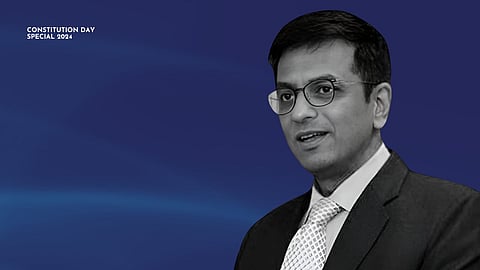

DHANANJAYA Yeshwant Chandrachud has retired from the highest judicial office of the Chief Justice of India. However, he has left the seat of justice raising a fundamental question of what drives a judge to form an opinion and decide contested cases.
The question has been raised because he disclosed that he had prayed to God for guidance in determining the politically sensitive litigation between Hindus and Muslims that involved an issue of who is entitled to the possession of land in Ayodhya for religious purposes.
It is a practice for lawyers in India and other commonwealth jurisdictions to address judges of superior courts as ‘Milord’ or ‘My Lord’. The phrase is a respectful form of address borrowed from the French word ‘Milor’, meaning a nobleman.
The phrase does not convey that judges are divinity or avatars of Ishwar (incarnations of God), or have any access to what the Supreme Being communicates, or have a higher cognitive faculty to receive revelations from the Almighty. If US judge Richard Posner's classic How Judges Think is read, it does not say judges look for any supernatural source before banging the gavel!
Sovereignty, law and God
Judges exercise sovereign power to decide disputes. Judges also apply the law and principles of equity to determine causes. If so, does God provide them the power or guide them?
Going back into history, the sovereign was believed to derive his authority to rule from God or divinity. The king was considered a god who exercised the State's legislative, executive and judicial powers to maintain peace and prosperity in the territory.
However, this changed. The Act of Supremacy of the English Parliament established the king as the head of the Church of England. Subsequently, during the Glorious Revolution in 1688, the idea that the king exercised the powers gifted by God lost its constitutional foundation.
With the dawn of the Age of Enlightenment, the belief that sovereign power flowed from divinity completely lost its legitimacy. English philosopher Thomas Hobbes, in his Leviathan, was the first to articulate the concept of a social contract as the basis for the foundation of the State.
Hobbes said that all legitimate political power must be representative and based on the consent of the people. The social contract theory promoted by John Locke advocated that the legitimacy of the sovereign’s power lies in the consent of the people. Locke undoubtedly laid the foundation of limited government theory.
Similarly, the Greek classical theories of law, in the development of which Cicero played a leading role, held that the law also flows from divinity. The ‘jus naturalism’ advocated that law is derived from God besides nature and reason. The ancient Dharmashastras in India is a natural law code sourced from spiritualism.
However, these theories lost out to modern natural law theories based on reasoning and moral values. The Declaration of Independence by the US in 1776 and the Declaration of the Rights of Man and of the Citizen in France in 1789 formalised the changes.
The theory of legal positivism advocated by Jeremy Bentham and John Austin gave these ideas shape. It made law simply a fiat issued by the political entity to adjust or regulate the relationship amongst individuals and between individuals and the State in the public interest guided by the utilitarian principle.
The doctrine of constitutionalism evolved, encapsulating the rule of law, freedom and equality. Under modern constitutions, the State as a political entity is established by the people by the political act of establishing the Constitution formally.
At present, it is beyond argument that representatives of the people make laws, the officials execute those laws and the judges decide disputes between individuals and between individuals and the State on rights under the Constitution in any country that professes democracy.
What does the Indian Constitution mandate?
The Indian Constitution, adopted by the Constituent Assembly on November 26, 1949, established the Republic of India. Even though under State succession in international law and Articles 294 and 295 of the Indian Constitution, the Republic of India is a successor to British India and hundreds of Princely States belonging to Hindu and Muslim rulers, the Preamble of the Constitution begins with the words: “We, the people of India…”
The sovereignty of the British Parliament in India, which was established through several Anglo-Indian wars, and the sovereignty of the Princely States, vested in the respective princes, were treated by legal fiction as the sovereignty belonging to the people of India that is Bharat.
The phrase ‘We, the people of India’, though a legal fiction, clarifies that people are the foundation of the Indian Constitution and sovereignty flows from them and not from hold will. This subject was settled during the debates on the Constitution itself. H.V. Kamath, a member of the Constituent Assembly of India from Central Provinces and Berar, tried to plead, “We have drawn up a very elaborate Preamble, but without the invocation of God,” but could not muster any support— and rightly so.
The hallmark of the Indian Constitution is that it is not anti-God or anti-religious rights. The natural right to practice religion is protected. Articles 25 and 26 reiterate this principle. Even the State’s support in promoting religion by spending tax-payers money is permissible, but it shall be without discrimination as mandated in Article 27.
The constitutional philosophy that emerges is that belief in God and religion are respected and protected in the private sphere while limiting their influence in the public sphere.
What oaths do judges take?
While separation of State and religion has been delicately ensured, a question still arises because constitutional judges are permitted by choice to take oath in the name of God as formatted in the Third Schedule of the Constitution.
However, on a close reading between the lines, it is clear that a judge may promise or swear in the name of God to “bear true faith and allegiance to the Constitution of India,” but the judge is expected to discharge his duties to the best of his “ability, knowledge and judgment” and uphold the Constitution and the laws.
While the judges have to decide by applying their knowledge as mandated by the Indian Constitution, they are not permitted to decide cases according to their faith or revelations as received, even though a judge is entitled to practice praying to God in his private sphere, as guaranteed under Article 25 of the Indian Constitution.
In an interview with the media, Justice Chandrachud asserted that he is entitled to pray to God as a fundamental right guaranteed under Article 25 of the Constitution. Why not? But, a prayer to God cannot be a justification for a judgment passed in a court of law.
Then what about judges referring to religious texts while declaring the law? The answer is that there is a distinction between praying to God and relying on custom based on revelations as evidence.
Ever since Lord Warren Hastings decree of 1772, judges in India have received Dharmashastras and the Quran as evidence to support custom and practice while determining what constitutes Hindu law and Mohammedan law in deciding personal disputes on, say, inheritance among Hindus and Muslims respectively.
But there are institutional difficulties if a judge invokes revelation. If a high court judge were to write a judgment stating that I prayed to God and decided this way, what would be the Supreme Court’s response?
If the revelation the high court judge received is not testable, it is not the source of a judge’s knowledge. Austrian Philosopher Karl Popper applied the falsifiability test to demarcate science from non-science.
Besides, the approach is also contrary to the doctrine of scientific temper mandated by Article 51(h) of the Indian Constitution.
If the source of sovereignty is ‘We, the people of India,’ and laws are the laws made by the Parliament and the state legislatures in the public interest, the ultimate source of judges' power to decide the dispute by law and principles of equity ought to be attributed to the will of the people and no one else.
No mystery in knowledge
What is knowledge is not res integra— something that is an integral, untouched thing that has not been examined. Epistemology has been engaging on the subject for centuries, from the time of Plato. Knowledge is justified by true belief. Belief that cannot be justified is faith and knowledge. Both these are different streams to unravel reality.
While the faith calls for prayer or meditation to access what God reveals, justified true belief known as evidence-based knowledge is sourced by the knower by his perception, inferences, reasoning and testimony of those who have perceived.
Of course, some say revelation from God could be knowledge if a human has higher cognitive faculties. US philosopher Alvin Plantinga says, “[T]heistic beliefs count as knowledge because they are produced by the operation of a special cognitive faculty whose functional design fits it for the purpose of generating true beliefs about God.”
Hindu philosophy on epistemology, known as nyaya, also recognises these sources of knowledge as pramanas (‘means of knowledge’ in Sanskrit). These means of knowledge in Sanskrit are: (i) pratyaksha (perception); (ii) anumana (inference); (iii) upamana (comparison); and (iv) sabda (testimony). (Gavin Flood and Rosanna Picascia offer insight into these subjects.) If so, God or revelation is not a source of pramanas or knowledge.
The Indian Evidence Act of 1872 and the supposedly decolonised Bharatiya Sakshya Adhiniyam of 2023 are founded on this basic principle of knowledge as sensory perception.
What X has not seen directly cannot be the evidence. Hearsay is barred, except in limited circumstances which do not include taking testimony from someone who claims revelation. Even in the provisions on judicial notice, the judge is not permitted to take notice of his revelation, if any.
However, despite a clear prescription under the Constitution that judges discharge duties based on knowledge by evidence rather than faith, judges are used to employing expressions such as ‘by the grace of God’.
However, such expressions are only figures of speech and are not used in a literal sense. Similarly, lawyers also tell their clients figuratively something like ‘we do our best by presenting the case and leaving it to God’.
If these expressions are symbolic, nothing should follow therefrom.
Closing the argument
Closing the argument, Justice Chandrachud is undoubtedly credited with progressive judgments during his long tenure in the high courts and the Supreme Court. However, his disclosure of prayer to God has left some disquieting and some even repulsed.
His progressivism on the rights of women, the disabled, privacy, etc., may lose much of its legitimacy if they are treated as gifts of God rather than recognised as natural rights retained by ‘We, the people of India’ while contracting the formation of the Indian Constitution.
Justice Chandrachud’s art of justicing is theoretically on the lines of Australian legal philosopher John Finnis, who says that the morality of law is taught by both reason and divine revelation.