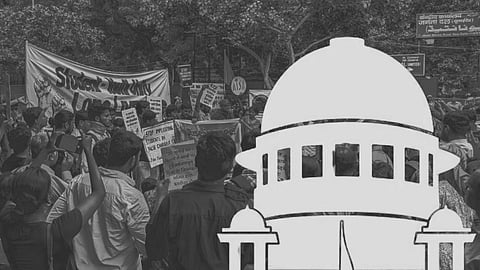

INVOKING ITS INHERENT POWERS, the Supreme Court on Tuesday quashed First Information Reports (‘FIRs’) against student protesters in connection with the protests held at Jantar Mantar and other parts of the country demanding the resignation of Education Minister Dharmendra Pradhan over the NEET paper leaks.
A Bench of Chief Justice of India (‘CJI’) Surya Kant and Justices Joymalya Bagchi and V. Mohan passed the order invoking its power under Article 142 of the Constitution of India.
The Bench passed the order on an application filed by the Delhi Police and the States of Maharashtra, Bihar and West Bengal. The Bench made it clear that its order would apply throughout the country. This means that any similar FIRs would stand closed even in those States that did not approach the Supreme Court with an application.
The Bench, however, granted liberty to the Delhi Police to file FIRs against as many as 2,873 individuals accused of offences relating to bodily harm or destruction of property at the protests.
The Bench clarified that the accused in the fresh FIR would have all the legal remedies against such FIRs.
Today’s order has come ahead of the proposed march to India Gate by the Cockroach Janta Party, which has now been called off after the Court’s order.
Saurav Das, the co-convenor of CJP, appeared before the Bench and submitted that the party intends to call off the proposed march in light of the order that was proposed to be passed by the Court to quash all the FIRs.
The Bench also directed the Union Government, in consultation with the State governments, to compensate those who died by suicide due to the paper leaks, as was promised by the Government of India to the representatives of CJP before they called off their agitation after the resignation of Pradhan.
The aftermath of the student agitations
The protests originated from widespread outrage over repeated examination paper leaks, particularly the NEET-UG 2026 paper leak. The protest was spearheaded by the CJP, which came into existence after Chief Justice Surya Kant compared unemployed youth to “cockroaches” and “parasites.” The Chief Justice later clarified that his remark was in the context of those lawyers who have fake degrees.
Students from all over India sat on dharna for weeks at Delhi’s Jantar Mantar. On July 20, the CJP organised a “Sansad Chalo” march towards Parliament, the day on which incidents of police excesses against students were reported.
A day before the scheduled march, well-known social activist and educator Sonam Wangchuk, who had been on an indefinite hunger strike in solidarity since late June, was picked up by the Special Staff and the Delhi Police and admitted to Safdarjung Hospital.
The agitation ended after Pradhan resigned on July 25. Two Union Ministers subsequently assured the CJP that cases against protesting students would be withdrawn.
Last month, the Supreme Court constituted a High-Powered Committee (‘HPC’) headed by former Supreme Court judge R. Subhash Reddy to inquire into the allegations of use of excessive force and violence by the Delhi Police against the protesting students at Jantar Mantar last month.
