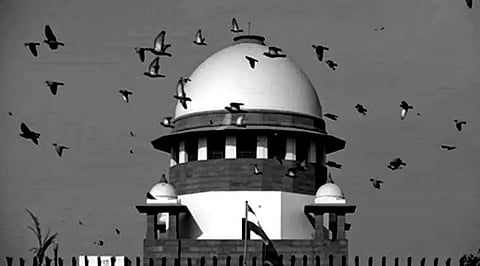

THE SUPREME COURT ON FRIDAY sought responses from the Central government and the Election Commission of India (‘ECI’) on a public interest litigation (‘PIL’) seeking to fill the vacuum in Section 62(5) of the Representation of the People Act, 1951 (‘RPA’) — a provision that currently imposes a blanket ban on voting by all prisoners, including undertrials who have not been convicted.
A Bench comprising Chief Justice B.R. Gavai and Justice K. Vinod Chandran issued notice on the plea filed by Sunita Sharma, represented by advocate Prashant Bhushan, which seeks to frame guidelines and conditions to end disenfranchisement of prisoners under the current law. “This is about the voting rights of about five lakh undertrial prisoners,” Bhushan told the Court.
The petition does not challenge the constitutional validity of Section 62(5) but instead seeks judicial guidelines to ensure that voting restrictions apply only under defined and proportionate circumstances—namely, pursuant to an individualised judicial determination, after final conviction for specific offences, or based on the length or nature of the sentence. The petitioner contended that the present blanket bar equates the undertrial with convicted prisoners.
The plea urges the Court to direct the government and the ECI to establish polling stations within prisons for local detainees and provide postal ballot facilities for prisoners held outside their home constituencies. It also seeks to exclude from the proposed voting rights only those convicted of corrupt practices or electoral offences.
