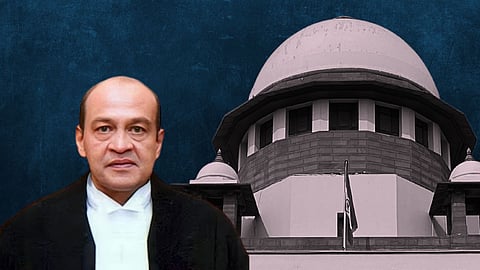

THE SUPREME COURT ON TUESDAY issued notice to the Lok Sabha Speaker and the Secretariats of both Houses of Parliament on a petition filed by Allahabad High Court judge Justice Yashwant Varma challenging the initiation of impeachment proceedings against him, alleging procedural violations under the Judges (Inquiry) Act, 1968.
A Bench of Justices Dipankar Datta and Augustine George Masih appeared prima facie unconvinced by the manner in which the impeachment process had been triggered, questioning how parliamentary legal advisers permitted what Justice Varma has described as a unilateral exercise of power by the Lok Sabha Speaker.
“So many MPs and legal experts but no one pointed this out?,” Justice Datta asked during the hearing.
The Court issued notice to the Speaker, as well as to the Lok Sabha and Rajya Sabha Secretariats, and is likely to hear the matter in the first week of January.
Justice Varma has assailed the decision of Lok Sabha Speaker Om Birla to constitute a three-member inquiry committee on August 12, 2025, contending that the Speaker acted without awaiting the admission of an identical impeachment motion moved before the Rajya Sabha Chairman on the same day it was presented to the Lok Sabha Speaker.
Stating that when impeachment motions are moved in both Houses of Parliament—Lok Sabha and Rajya Sabha—neither presiding officer can proceed unilaterally, Justice Varma has argued in his petition:
“The Hon'ble Speaker has acted in clear derogation of the proviso to Section 3(2) of the Judges (Inquiry) Act, 1968, by unilaterally constituting a Committee on 12.08.2025 after admitting a motion given before the Lok Sabha on 21.07.2025, as on the very same day a separate motion was given in the Rajya Sabha which had not been admitted.”
The proviso to Section 3(2) of the 1968 Act states:
“Provided where notices of a motion referred to in sub-section (1) are given on the same day in both Houses of Parliament, no Committee shall be constituted unless the motion has been admitted in both Houses and where such motion has been admitted in both Houses, the Committee shall be constituted jointly by the Speaker and the Chairman.”
Sections 3(1)(a) and 3(1)(b) of the Act provide that a motion for the removal of a judge may be moved in the Lok Sabha with the support of not less than 100 members, and in the Rajya Sabha with the support of not less than 50 members. However, where such motions are moved simultaneously in both Houses, the proviso to Section 3(2) becomes operative.
The impeachment proceedings stem from an incident on March 14, when a fire broke out at Justice Varma’s official residence in New Delhi. Firefighters allegedly recovered unaccounted cash from the premises, visuals of which later surfaced showing bundles of currency burning in the fire.
Justice Varma and his wife were out of station at the time, travelling in Madhya Pradesh. His daughter and elderly mother were present in the house when the fire occurred. Justice Varma has denied all allegations, claiming he is being framed.
Following the incident, then Chief Justice of India Sanjiv Khanna (since retired) constituted an in-house committee comprising three High Court judges, which submitted its report on May 4 indicting Justice Varma. CJI Khanna gave Justice Varma the option of resigning. When Justice Varma declined to resign, the report and his response were forwarded to the President and the Prime Minister, leading to impeachment motions being moved in Parliament.
A motion signed by 146 Members of Parliament was admitted in the Lok Sabha, following which Speaker Om Birla constituted a committee comprising Supreme Court Justice Aravind Kumar, Madras High Court Chief Justice Manindra Mohan Shrivastava, and Senior Advocate B. Vasudeva Acharya.
The committee sought Justice Varma’s response, but he requested authenticated copies of the motions admitted in both Houses and any consequential orders. He has claimed that no response was received, prompting him to challenge the proceedings before the Supreme Court. His time to respond to the committee has since been extended till January 12, with a personal appearance scheduled on January 24.