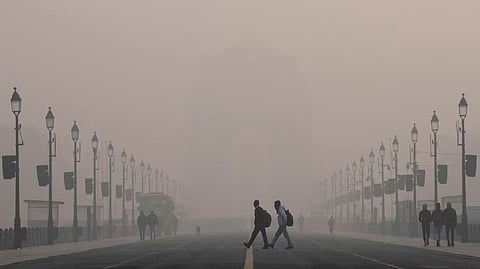
Supreme Court declines to interfere with Delhi government’s decision to suspend physical classes up to Class 5 amid pollution

Senior Advocate Menaka Guruswamy, appearing for a group of parents, argued that the suspension of physical classes adversely impacted children from economically weaker sections.
Supreme Court declines to interfere with Delhi government’s decision to suspend physical classes up to Class 5 amid pollution
Published on

The Supreme Court on Wednesday declined to interfere with the Delhi government’s decision to suspend physical classes up to Class 5 from December 15, in view of the hazardous air quality levels in the national capital. The Court noted that the measure was temporary in nature and left the issue to be considered by the Commission for Air Quality Management (‘CAQM’).

A Bench comprising Chief Justice Surya Kant, and Justices Joymalya Bagchi and Vipul Pancholi observed that it was not inclined to interfere at this stage, particularly since schools were set to close shortly for the winter vacation. The bench was hearing applications questioning the Delhi government’s decision to suspend physical classes from Nursery to 5th standard.

“Complete suspension of physical classes affects children from economically weaker sections”: Meneka Guruswamy

Senior Advocate Menaka Guruswamy, appearing for a group of parents, argued that the suspension of physical classes adversely impacted children from economically weaker sections. She pointed out that many such children depend on schools for midday meals and questioned the rationale behind shutting classrooms when children were not contributors to air pollution.

Guruswamy submitted that the parents of the affected children continued to work outdoors despite the pollution.

Guruswamy submitted that the parents of the affected children continued to work outdoors despite the pollution, and questioned whether the air quality inside their homes was any better than in school classrooms. She also reminded the Court that it had earlier indicated that a hybrid mode could be considered, arguing that the present arrangement benefitted only those parents who could afford to keep their children at home.

Responding to the submissions, the CJI remarked that courts could not assume the role of “super specialists” and sit in judgment over policy decisions taken by expert bodies. CJI also noted that the closure was only for a few days, with winter vacations commencing the following week.

“Hybrid model meant to strike balance between health and access to education”: Aparajita Singh

Senior Advocate Siddharth Luthra, representing another set of parents seeking hybrid classes, submitted that pollution levels were at their worst in the early mornings when children were required to travel to school. The CJI, however, cautioned that a hybrid model could itself create inequality, observing that those with access to digital resources would be able to protect themselves, while others would be forced to remain exposed.

Supreme Court declines to interfere with Delhi government’s decision to suspend physical classes up to Class 5 amid pollution
Delhi air pollution: Court has no magic wand; only experts can find solutions, says SC

Amicus curiae Aparajita Singh informed the Court that under GRAP-IV measures notified by the CAQM, hybrid learning was contemplated, but the Delhi government had gone a step further by suspending physical classes for younger children. She said the hybrid model was meant to strike a balance between health concerns and access to education.

Additional Solicitor General Aishwarya Bhati, appearing for the Delhi government, said the decision was taken on December 15 after the city was enveloped in thick smog, pushing the Air Quality Index to alarming levels. She submitted that the move was intended to protect young children and would also help reduce traffic congestion.

Declining to interfere, the Bench observed that similar pleas in the past had been placed before the CAQM. “Schools for children up to Nursery to Class 5 have been closed temporarily, and winter break is about to begin. In these circumstances, there is no need for this Court to intervene,” it said.

Related Stories

No stories found.
The Leaflet
theleaflet.in