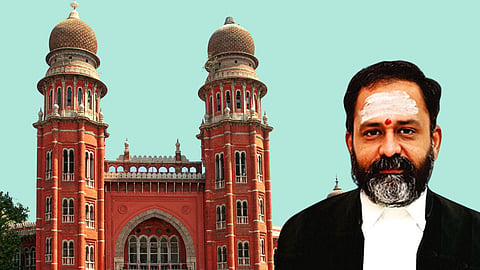

AS MANY AS 107 opposition Members of Parliament (‘MPs’) from the Lok Sabha have submitted a motion for the removal of Madras High Court Judge, Justice G. R. Swaminathan. The notice alleges:
The conduct of Justice G. R. Swaminathan raises serious questions regarding his impartiality, transparency, and commitment to the secular functioning of the judiciary;
Undue favouritism shown to one Mr M. Sricharan Ranganathan, Senior Advocate, in deciding cases, as well as favouring advocates from a particular community;
Deciding cases on the basis of a particular political ideology and in violation of the secular principles enshrined in the Indian Constitution.
The signatories to the motion include MPs A. Raja, Supriya Sule, Dimple Yadav, Asaduddin Owaisi, Gaurav Gogoi, and many others.
The motion was submitted to Lok Sabha Speaker Om Birla yesterday, jointly by MPs Priyanka Gandhi, Kanimozhi Karunanidhi, Akhilesh Yadav, and others.
Article 124(4) of the Constitution provides that a Judge of the Supreme Court shall not be removed from office except by an order of the President passed after an address by each House of Parliament, supported by a majority of the total membership of that House and by a majority of not less than two-thirds of the members present and voting, has been presented to the President in the same session for such removal on the grounds of proved misbehaviour or incapacity.
Article 218 of the Constitution extends the provisions of Articles 124(4) and 124(5) to High Court judges. Thus, the procedure for removing a Judge of the Supreme Court or a High Court is the same.
Under the Judges (Inquiry) Act, 1968, which regulates the procedure for the investigation and proof of the misbehaviour or incapacity of a Judge of the Supreme Court or a High Court, the process to remove a judge is initiated when a motion signed by at least 100 members in the case of the Lok Sabha (or 50 members in the case of the Rajya Sabha) is admitted by the Speaker or the Chairperson, as the case may be.
If the Speaker admits the motion, he is required to constitute a three-member inquiry committee comprising: (a) one member chosen from among the Chief Justice and other Judges of the Supreme Court; (b) one Chief Justice of a High Court; and (c) a distinguished jurist, in the opinion of the Speaker.
At present, Justice Yashwant Varma of the Allahabad High Court is facing an inquiry under the Judges (Inquiry) Act after sacks of burnt currency notes were allegedly discovered at his official residence.
The tale of lighting of the Karthigai Deepam
Justice Swaminathan recently sparked controversy when, on December 1, 2025, he directed the temple management/devasthanam to light the Karthigai Deepam at Deepathoon, in addition to the usual locations. The State opposed the order, citing law and order concerns and the hill’s proximity to a dargah.
When the order was not complied with, Justice Swaminathan heard a contempt petition and permitted the petitioners to ascend the hill and light the lamp at Deepathoon, situated on Thirupparankundram Hill. He allowed the petitioners to be accompanied by ten others, including the co-petitioners. He also directed the Commandant, CISF Unit, Madurai Bench of the Madras High Court, to provide a team of CISF personnel to protect the petitioners while carrying out the court’s order.
An appeal filed by the District Collector, Madurai, and the Commissioner of Police, Madurai, against the contempt order was dismissed by a Division Bench, which held that the appeal had been filed with the ulterior motive of pre-empting contempt action.
On December 4, 2025, Justice Swaminathan again took up the contempt petition. He noted that although the petitioners, accompanied by CISF personnel, had reached the foothill, J. Loganathan, IPS, Commissioner of Police, Madurai City, prevented them from proceeding further, citing an order under Section 163 (erstwhile Section 144 CrPC) of the Bharatiya Nagarik Suraksha Sanhita (‘BNSS’), 2023, promulgated by the District Magistrate and Collector, Madurai.
As a result, the CISF team returned, and the petitioners, despite the court’s express permission, were unable to light the Deepam.
The judge observed that December 4 was “Sarvalaya Deepam Day” and that the Karthigai Deepam could therefore still be lit on that day. He issued a fresh order maintaining all previous directions except for the deployment of CISF personnel and the change of date. He listed the matter for compliance on December 5, 2025 at 10:30 a.m.
On December 5, 2025, Justice G. R. Swaminathan adjourned the contempt petition to December 9, 2025 after noting that the State and the temple management had filed writ appeals before the Division Bench and that the State had also filed a petition before the Supreme Court challenging the Division Bench’s dismissal of appeal against the contempt order.
Interestingly, in 2014, the Madras High Court had rejected a similar petition seeking to light the Karthigai Deepam (which fell on December 5, 2014) on the top of Thirupparankundram Hill instead of at the existing Motchai Deepam site.
Justice Swaminathan, however, distinguished the earlier judgment by pointing out that the present petitioners were not insisting on lighting the lamp at the hilltop itself. They only sought permission to light it at the Deepathoon, which is located on the lower of the two peaks — the higher peak being occupied by the dargah.
Justice Swaminathan has been criticised for his views on the Constitution
Earlier this year, former Madras High Court judge Justice K. Chandru criticised Justice G. R. Swaminathan for describing the Indian Constitution as a “copied” document largely derived from the Government of India Act, 1935, and claiming that it lacked originality. Justice Swaminathan had made these remarks while speaking at an event organised by the Rashtriya Swayamsevak Sangh (‘RSS’) in Haryana.
In 2023, Justice Swaminathan said that the Constitution of India would cease to exist if the country’s “demographic profile” that prevailed at the time of its adoption were significantly altered.
Justice Swaminathan describes himself as a first-generation lawyer in his profile on the Madras High Court website. He previously served as standing counsel for several public sector undertakings and was appointed Assistant Solicitor General of India for the Madurai Bench in 2014. He was elevated as an Additional Judge of the Madras High Court in June 2017 and was later confirmed as a permanent judge. He is due to retire in 2030.