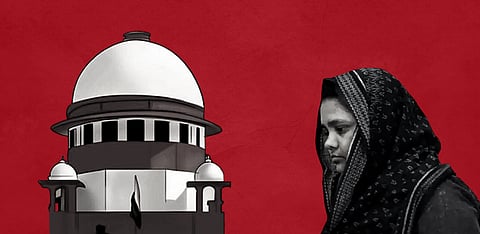

Days after the Supreme Court suspended the life sentences of two of the convicts in the gruesome vioelnce and rape suffered by Bilkis Bano case linked to the 2002 Gujarat pogrom, the survivor Bilkis Bano has said she was not even heard before the sentences were suspended.
“I was a young girl, just 19 years old, when my world, my baby daughter, my family, my home, and my trust in humanity were brutally wrenched from me. For 24 long years since that day, I have stood up to fight for justice—for myself and for women everywhere—again and again and again. For 24 years I have searched for and found reservoirs of courage I did not know I had, only because a million voices of support and solidarity came my way,” Bano said in her statement.
She added: “Yet today I find myself losing the very justice I had fought so hard to win. Familiar fears are resurfacing. I am scared once again—for myself, my family, and my children. And I am scared of losing faith in justice, yet again. How could the honourable Supreme Court simply suspend the sentences of the men who did this to me? How could they not even inform me? How could they not even make sure my voice was heard in their courtroom?”
On 28 October 2026, a Bench of Justices M.M. Sundresh and P.B. Varale suspended the life sentences of convicts Bipinchand Kanaiyalal Joshi @ Lala Doctor and Pradip Ramanlal Modhiya. As per the case status available on the Supreme Court’s website, Bilkis has not even been made a party to the case, nor did the court order her to be impleaded as a party.
The only reasoning the Bench has offered for suspending the sentences of the two convicts is that they have suffered incarceration for a period of more than seventeen years, and that one of the appellants has a severe handicap.
The decision to suspend the sentences of two convicts in a case of gruesome rape and murder, and that too without hearing the survivor, has drawn criticism from many quarters of civil society.
The decision also flies in the face of a binding precedent of a three-judge Bench of the Supreme Court in Jagjeet Singh v. Ashish Mishra, in which it was held that victims have a legally vested right to be heard at every step post the occurrence of an offence. Such a ‘victim’ has unbridled participatory rights from the stage of investigation till the culmination of the proceedings in an appeal or revision.
In a public statement, the People’s Union for Civil Liberties (PUCL) has condemned the grant of bail to the convicts. It said: “The Supreme Court order does not take into account the question of the security of the victim, nor does the court record the severe mental stress which would befall Bilkis Bano when the accused go to their own village, which is also the village where she and her family live.”
“The interests and safety of the victim and her family, being residents of the same village where the convicts will return, ought to be considered, and bail can be granted only with cogent reasons. It cannot be done through a cursory order as in the present instance, going against judicial conventions,” PUCL added in its statement.
Highlighting the nature of the violence Bano faced, PUCL said: “Reflecting upon the riots, one cannot say the words ‘systemic failure’ without saying the name of Bilkis Bano in that same breath. Then twenty-one years old, Bilkis Bano, pregnant and trying to escape anti-Muslim communal violence, was caught in a mob. This mob attacked her and her family, including women and children, with lethal weapons, and gang-raped them.”
“In a short swoop of senseless violence, Bilkis Bano watched 14 members of her family being butchered at the hands of that brutal mob, one of them being her own three-year-old daughter. She only survived because she was assumed dead by the mob,” PUCL said.
This is not the first time that the case of Bilkis Bano has come to the fore. In 2022, the Gujarat Government, without even having the competence to grant remission, granted remission to all 11 convicts in the Bilkis Bano case. A Bench of Justices B.V. Nagarathna and Ujjal Bhuyan in January 2024 quashed the decision of the Gujarat Government and the Ministry of Home Affairs granting remission to the convicts, and ordered them to surrender.
Justice Nagarathna had held that the grant of remission by the Gujarat government was a usurpation of the power of the Maharashtra government and against the rule of law.
The trial in the case of Bilkis Bano was held in Maharashtra, and hence, as per law, it was the Maharashtra government which had jurisdiction to consider the remission of convicts in this case. The Supreme Court bench led by Justice Nagarathna had also found that the convicts played fraud on the court by suppressing material information.
Bilkis was 21 years old and pregnant when she was gang-raped. She lost all the members of her family in the communal carnage. Her three-and-a-half-year-old daughter was butchered to death before her eyes. The Central Bureau of Investigation (CBI), on the direction of the Supreme Court, investigated the matter, and the trial was held in Maharashtra on the directions of the Supreme Court to ensure an impartial investigation and fair trial.
Isn’t a travesty of justice and fair play that the convicted criminals were released on bail after remission of the life sentence even without hearing the victim?
