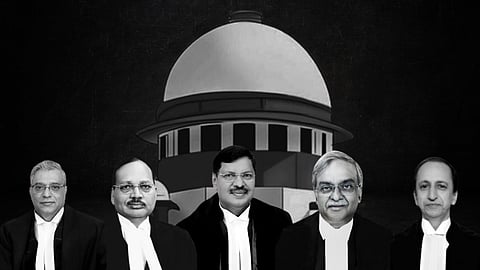

IN ITS ADVISORY OPINION on a Presidential Reference, a five-judge Constitution Bench of the Supreme Court today overruled its April 8 judgment and held that the President and Governors cannot be bound by judicially imposed timelines for acting on Bills presented for assent, their decisions under Articles 200 and 201 are not justiciable, and the concept of ‘deemed assent” does not exist under the constitution as one constitutional authority cannot substitute the role and powers of another constitutional authority.
Emphasising that courts cannot prescribe “judicially mandated timelines,” nor invoke Article 142 to create “deemed assent,” the Bench—comprising Chief Justice B.R. Gavai, Chief Justice-designate Justice Surya Kant, and Justices Vikram Nath, Pamidighantam Sri Narasimha and Atul S. Chandurkar—however clarified that courts may intervene in cases of “prolonged, unexplained and indefinite inaction,” to prevent constitutional standstill.
The Court reiterated that, “In the absence of constitutionally prescribed time limits, and the manner of exercise of power by the Governor, it would not be appropriate for this Court to judicially prescribe timelines for the exercise of powers under Article 200.” It added that for the same reasons, “the President, too, cannot be bound by judicially prescribed timelines in the discharge of functions under Article 201.”
It further held that decisions of the Governor and President under Articles 200 and 201 are not open to judicial scrutiny until after a law comes into force. Courts cannot examine the contents of a Bill or review the merits of the decision at a pre-enactment stage. The Court clarified that its exercise of advisory jurisdiction under Article 143 does not amount to “judicial adjudication.”
Addressing the scope of judicial review vis-à-vis immunity, the Court stated: “Article 361 of the Constitution is an absolute bar on judicial review in relation to personally subjecting the Governor to judicial proceedings. However, it cannot be relied upon to negate the limited scope of judicial review that this Court is empowered to exercise in situations of prolonged inaction by the Governor under Article 200. It is clarified that while the Governor continues to enjoy personal immunity, the constitutional office of the Governor is subject to the jurisdiction of this Court.”
