In AMU’s forgotten Kerala campus, students wage a lonely war against maladministration and embezzlement

In Aligarh Muslim University’s Malappuram campus, students uncovered financial irregularities running into lakhs forcing the provost to resign earlier this month. It has been a battle for the Sachar Committee’s promise of educational excellence for India’s marginalised communities.
In AMU’s forgotten Kerala campus, students wage a lonely war against maladministration and embezzlement
Published on

NESTLED AMIDST THE VERDANT HILLS of Kerala’s Malappuram district lies a campus of national importance that has remained largely invisible from public scrutiny. The Aligarh Muslim University Centre at Malappuram (‘AMUMC’) is home to over four hundred students from more than seventeen different states. Lately, it has become an unlikely epicenter of recurring protests against what students allege is entrenched administrative corruption. 

At the heart of these accusations stand two figures – the Director and the Provost – whose financial management has sparked unprecedented student unrest and raised fundamental questions about institutional oversight and accountability. On reaching the director and the provost for an interview about the ongoing protests and corruption allegations against them, no response was received.

A pattern of financial irregularities

The current crisis erupted in March when some students uncovered a probable systematic embezzlement by the administration. It is alleged by the student fraternity that the provost working in collusion with the director has misappropriated surplus funds amounting to Rs 3,88,408 for the 2023-24 session. This discovery was particularly troubling since the mess operations are entirely funded by student fees, with the parent institution in Aligarh repeatedly citing financial constraints for its inability to support its satellite campuses adequately.

“I have lived on campus for the past three years, and each year there has been at least one protest over inadequate medical facilities, etc.,” said Shamim Akhtar, a student leader from the Senior Hall (boys’) in AMUMC

Student protests eventually led the administration to agree to adjust the surplus amount against the upcoming month’s mess fees. However, this concession appears to have triggered a retaliatory response from the administration. On April 8 the provost’s office issued a notification claiming a sudden and unprecedented deficit of Rs 3,95,157 for March, the month of Ramadan. The timing and amount – strikingly similar to the previously disputed surplus – immediately aroused suspicion among the student body.

Adding to the students’ concerns, this alleged deficit occurred during a period when substantial photographic evidence documents the serving of stale and expired food of substandard quality in the mess facilities. Further compounding these irregularities, an iftar party was organised during Ramadan which was presented as a personal gesture by the director and provost. However, sources within the administration suggested that only a portion of the funding came from them, with the remainder drawn from student mess funds.

In AMU’s forgotten Kerala campus, students wage a lonely war against maladministration and embezzlement
Booking 14 Aligarh Muslim University students for sedition shows how the State misuses an obsolete, unconstitutional law

“I have lived on campus for the past three years, and each year there has been at least one protest over inadequate medical facilities, etc.,” said Shamim Akhtar, a student leader from the Senior Hall (boys’) in AMUMC, “The current protest is more serious and concerns the mismanagement of student funds by the administration. The admin claims a financial deficit and is demanding additional payments from students, supported by what I believe to be inflated bills and shoddy bank statements.”

In reality, Akhtar told The Leaflet that during the past three Ramadans, the same food menu was provided without any deficit. In fact, the previous sessions had a surplus of approximately Rs 3.8 lakh. It now appears that the administration is trying to recover this surplus by imposing an unnecessary deficit on students, leading to continuous protests for the past three days.

“We have approached the parent administration multiple times, including the Vice Chancellor, the Dean of Faculty, the Nodal Officer of the Center, and the Proctor.Most of the time, they attempted to resolve the issues by delegating the matter to the center's administration,” Akhtar told The Leaflet, “Regardless of the ongoing issues, the administration of the main campus has never visited the center in person to assess the actual conditions, since around the past six years.”

The current director of the center initially served as an interim director but has continued in the role as an acting director since 2019. “I would like to respectfully request the parent administration to consider appointing a director from the main center at Aligarh,” Akhtar requested, “Doing so would help establish a better connection between the two administrations, facilitate smoother coordination, and ultimately contribute to the development of the center.”

Mosharraf Ahsan, a student leader and ex-mess secretary alleged that the director and provost had embezzled money on multiple accounts, beyond only the students’ mess fee. “I am trying to acquire evidence which might showcase their attempts to mislead the students by showcasing false narratives, documents, etc.” Ahsan said.

Ahsan explained that although the director was not a member of the mess committee, due to his position, he had oversight over the mess funds and could have stopped the mismanagement and siphoning of public funds. Ahsan and a group of students have been gathering evidence through RTI and other sources, that they claim, indict the director more directly in other matters of mismanagement.  

Hostel rooms barely meet minimum AICTE dimensional standards, with three students sharing each space.

The confrontation

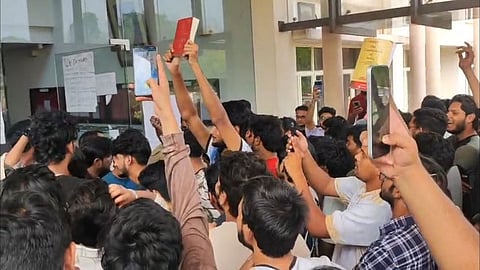
On April 9, the accumulated grievances culminated in a formal protest with students explicitly demanding the resignation of both the director and the provost. The students have characterised the conduct of the administration as an evasion of accountability. The director reportedly took leave immediately after the deficit notice was issued, seemingly to avoid confronting the mounting allegations. Beyond leadership changes, protesters have called for an independent financial audit to examine what they believe may be years of systematic misappropriation.

This pattern of confrontation has become distressingly routine in the campus, with students reportedly compelled to exercise their right to protest against administrative excess, at least once in a semester and at times, thrice. Such frequency suggests not isolated incidents but rather endemic governance failures that have fostered a deeply adversarial relationship between students and the administration.

On April 12, under mounting pressure by student agitations, the provost succumbed to the demands and submitted his resignation to the director which was promptly received but not accepted.

The protesting students rejoiced on achieving one of the goals of their protest and have halted the agitation for the time being after being assured by the Aligarh administration that a dedicated team would visit the AMU Kerala campus to investigate the allegations further. Accordingly it would decide whether departmental proceedings against the director and the provost would be initiated.

Beyond financial misconduct

The financial irregularities represent only the most visible aspect of a more comprehensive institutional neglect. Despite the AMUMC website showcasing the term “semi-permanent hostels,” these structures were originally sanctioned for merely a few years following the center’s establishment. Almost fifteen years later, these supposedly temporary accommodations in dilapidated conditions continue to house students.

In AMU’s forgotten Kerala campus, students wage a lonely war against maladministration and embezzlement
Playing with immunity: Mired in illegalities, South Asian University harassed students and international staff as Hindu right-wing forces enjoyed free pass

The living conditions raise serious questions about student welfare. Hostel rooms barely meet minimum AICTE dimensional standards, with three students sharing each space. More alarming are structural issues including false ceilings which are in a constant state of leakage that reportedly allow venomous reptiles to enter during breeding seasons. Despite charging approximately Rs 1,200 per student per semester for utilities, the administration maintains complete opacity regarding how these fees are calculated or utilised.

Basic safety protocols are not in place anywhere in the campus. The administration has been accused of overlooking fire safety guidelines as issued by governmental building safety and protocols bodies. This apparent negligence places hundreds of young students at risk in a remote location where emergency response capabilities are already limited and where the institute virtually has no medical response team at standby. Reaching the nearest medical emergency ward without the availability of an ambulance takes at least thirty minutes in the best conditions. On past occasions, snake and scorpion bites have led to chaos as students have scampered to take the victim to the closest medical facility at the earliest under life threatening circumstances. 

Ahsan exclaimed that the mess fund mismanagement is only the tip of the ice-berg - if mess funds are being siphoned while there is a student led mess committee to manage its functioning, what might be happening in other sectors where there is complete opacity of scrutiny? 

To corroborate this probable assumption, Ahsan has filed RTIs and are in contact with the central administration of AMU.

AMUMC is now at a turning point. An institution once founded on high ideals is struggling to serve the very people it was meant to help.

An institutional identity crisis

The situation at AMUMC reveals a profound disconnect between the institution’s founding vision and its current reality. Established as part of a broader initiative following the Sachar Committee report, AMU centers were intended to address educational disparities in regions with significant Muslim populations. These satellite campuses were originally conceived as incubators that would gradually evolve into independent institutions serving minority communities.

Instead, AMUMC appears caught in an institutional limbo – neither receiving adequate support from its parent institution nor developing the autonomy necessary to address its particular challenges. When students appeal to the main campus in Aligarh, their pleas fall on unconcerned ears. This neglect creates a vacuum of oversight that enables governance failures - now manifesting as financial irregularities.

The director’s unusually long tenure as an acting director holding office continuously since 2019, exemplifies the shoddy governance in which the central body of AMU might also be involved. Without proper rotation of leadership or effective external oversight, the conditions become ripe for administrative misconduct. 

What should be a dynamic educational institution devoted to community upliftment has instead become vulnerable to exploitation of students largely from low-income backgrounds.

National significance and political dimensions

The struggles at the Kerala campus carry implications far beyond local administrative disputes. AMUMC represents a critical test case for national commitments to educational equity and institutional accountability. The apparent dysfunction undermines the core objectives of the Sachar Committee recommendations, which specifically identified educational access as essential for socio-economic advancement of minority communities.

The situation has begun attracting political attention, albeit belatedly and in rare occurrences. On March 11 Indian Union Muslim League leader and Member of Parliament Abdul Wahab raised the issue in Rajya Sabha, advocating for either proper funding allocation or the return of the allotted land to the Kerala government “so that it can utilize it by opening a new university”. There is growing frustration with the persistent inability to fulfill the center’s original mandate.

Protesting students offer friday namaaz

The alleged mismanagement at AMU centers in Malappuram, Murshidabad, and Kishanganj receives minimal national media coverage, mirroring the parent institution’s pattern of neglect. This media blind spot and lack of scrutiny from the civil society enables administrative misconduct to continue unhindered, as those responsible face limited external inquiry.

Accountability and renewal

AMUMC is now at a turning point. An institution once founded on high ideals is struggling to serve the very people it was meant to help. The current financial allegations  demands an honest, independent audit. This is not just about one misplaced figure. It is about a pattern of financial mismanagement that must be addressed head on.

In AMU’s forgotten Kerala campus, students wage a lonely war against maladministration and embezzlement
Delhi University as a microcosm of a police state

At the same time, it is clear that governance issues run deep. There is a troubling link between long-standing leadership and the administrative problems we see today. This situation calls for setting term limits and establishing stronger oversight. The parent institution must either step in and truly supervise these centers or give them the real autonomy and resources they need to thrive.

Above all, what is at stake here is the original promise that led to the creation of these centers: a commitment to educational excellence for marginalised communities. 

Loading content, please wait...

Related Stories

No stories found.
The Leaflet
theleaflet.in