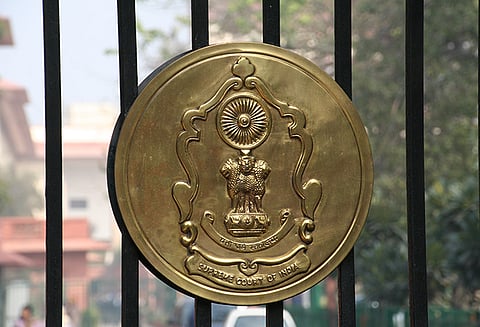

THE SUPREME COURT ON FRIDAY came down heavily on a petitioner NGO United Voice for Education Forum, which was seeking to reopen its 2014 Constitution Bench ruling that exempted minority educational institutions from the Right to Education (‘RTE’) Act. The Court termed the plea an impermissible attack on the authority of the apex court and imposing costs of ₹1 lakh on the petitioner NGO.
A Bench comprising Justices B.V. Nagarathna and R. Mahadevan expressed strong disapproval of the plea filed by United Voice for Education Forum, viewing it as an attempt to undermine the finality of judgments delivered by the Supreme Court.
“You cannot do this to the Supreme Court. We are enraged. This is against the entire system of judiciary in this country if you start filing such cases. You don’t know the seriousness of your case,” Justice Nagarathna observed. “We are restraining ourselves to imposing a cost of ₹1 lakh. Don’t bring down the judiciary of this country by filing such cases,” she added.
The Bench also questioned how legal advice could have been given to invoke Article 32 to directly challenge a binding judgment of the Supreme Court.
“What is happening here? Advocates are giving such kind of advice? You are law-knowing citizens and professionals, yet you file a writ petition challenging a judgment of this Court under Article 32,” the Court observed, “This is the grossest abuse.” The Court clarified that it was refraining from initiating contempt proceedings.
Ordering the payment of ₹1 lakh as costs, the Bench remarked, “Let this be a message to others. You want to crumble the judiciary of this country.”
The petition had sought a declaration that the exemption granted to minority educational institutions — both aided and unaided — from the obligations of the RTE Act, as upheld in Pramati Educational and Cultural Trust v. Union of India (2014), was unconstitutional. It further prayed that all minority institutions be directed to comply with Section 12(1)(c) of the RTE Act, which mandates reservation of 25 per cent seats at the entry level for children from weaker and disadvantaged sections of the society.
The NGO also sought the constitution of an expert committee to recommend a framework reconciling Article 30, which protects minority rights to establish and administer educational institutions, with Article 21A, which guarantees the right to education.
The petition had been filed barely three months after another Bench of the Supreme Court — comprising Justices Dipankar Datta and Manmohan — expressed doubts about the correctness of the 2014 Constitution Bench ruling and referred the issue for consideration by a larger Bench. In that order, the Court had observed that exempting minority institutions from the RTE Act could dilute the vision of common schooling and inclusivity underlying Article 21A.
Despite that reference being pending, the Bench on Friday made it clear that a direct writ petition assailing an existing judgment of the Supreme Court was wholly impermissible.
A five-judge Constitution Bench, in its unanimous judgment dated May 6, 2014, had upheld the constitutional validity of the RTE Act, 2009, while holding that its provisions would not apply to minority educational institutions, whether aided or unaided, protected under Article 30(1) of the Constitution.
The Bench—comprising Chief Justice R.M. Lodha and Justices A.K. Patnaik, Sudhanshu Jyoti Mukhopadhaya, Dipak Misra and Fakkir Mohamed Ibrahim Kalifulla (all since retired) —had held that the 86th Constitutional Amendment (inserting Article 21A) and the 93rd Constitutional Amendment (inserting Article 15(5)) did not alter the basic structure of the Constitution. At the same time, it ruled that applying the RTE Act to minority institutions would violate their constitutional protection under Article 30.
The ruling was delivered in response to a reference by a three-judge bench made in Society for Unaided Private Schools of Rajasthan v. Union of India (2012).