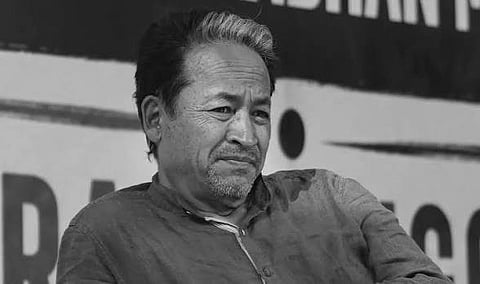

YESTERDAY, the Delhi High Court refused to pass an interim order to discharge Sonam Wangchuk from the Safdarjung Hospital and choose a hospital of his own choice. It noted that the activist’s forcible removal from the protest site at Jantar Mantar and his subsequent shifting to the hospital did not amount to an arbitrary action.
Justice Mini Pushkarna, who heard the matter, observed that the final call on assessing Wangchuk’s medical condition would rest with the medical team attending to him. The matter has now been listed for further hearing on July 24.
Background
Since June 6, Jantar Mantar in New Delhi has been the site of protests demanding the resignation of Union Education Minister Dharmendra Pradhan over the 2026 NEET paper leak, along with broader reforms in the conduct of public examinations. Activist Sonam Wangchuk began an indefinite hunger strike at the site on June 28 which drew progressively larger and more diverse crowds, including senior citizens, social organisations, and members of opposition parties.
On the morning of July 18, on Wangchuk’s 21st day without food, personnel identified as belonging to the New Delhi district’s Special Staff and local police entered the barricaded protest zone in civil clothes, and along with Rapid Action Force and Central Reserve Police Force, screened off Wangchuk with large white sheets and then lifted him from the stage before escorting him out of the site.
The Deputy Commissioner of Police (‘DCP’), Delhi then informed that “on expert medical advise due to the deteriorating health condition,” of Wangchuk, he had been shifted to the hospital for essential medical care.
Earlier a Division Bench of the High Court’s Chief Justice D.K. Upadhyaya and Justice Tejas Karia passed an order on July 16 directing that Wangchuk’s medical condition be regularly monitored on daily basis and depending on the opinion of the doctors whatever medical intervention is required to check his deteriorating health condition, shall also be taken.
On July 19, Wangchuk’s wife, Gitanjali Angmo, took to social media to say that she had “lost faith in Safdarjung Government Hospital” (where he was taken by the State) and had moved the High Court for an urgent hearing, seeking permission to shift him to a hospital of their own choosing before his condition worsened further. In her post, Angmo asserted that the hospital had earlier informed the family that Wangchuk’s potassium level had fallen to 2.9 (when it was 4.3 the previous day), which was dangerously low. She said that after ten hours and several requests, the family was finally given a blood sample at 10:30 p.m., and that an independent lab test on that sample came back at 3.5, well within the normal range.
Describing roughly 30 police personnel stationed on their floor and over 100 across the hospital as severely restricting the family’s movement, she characterised the situation as “illegal detention.”
Petitioner’s Claims
Appearing for the petitioner, Senior Advocate Kapil Sibal told the Court that the family had already spoken with Medanta Hospital in Gurugram and wished to shift Wangchuk there. “Because he’s neither under detention, nor is there any offence that he’s alleged to have committed, we are entitled to a doctor, and a hospital of our choice,” he told the Court. “How can you say that I want this person to remain in a government hospital? Under what provision of law can you do that?,” he questioned.
Sibal further stated that the petitioner had no objection to doctors from AIIMS and Safdarjung being associated with his treatment even at Medanta. He pointed out that Wangchuk had undertaken far longer hunger strikes in the past, of up to 30 to 35 days, and had withstood them without any medical intervention. It was submitted that he was being confined to Safdarjung without his or his family’s consent.
“I am not saying I don’t want treatment. I want treatment, but I want treatment at a hospital of my choice. How can the government object to that?,” Sibal submitted.
The delay in providing the family with blood samples set against the hospital’s low reading of potassium was cited as the reason the family’s trust in the treating hospital had broken down, leaving Wangchuk unwilling to continue treatment there.
Respondent’s Submissions
Appearing for the Union of India, Additional Solicitor General (‘ASG’) Chetan Sharma and senior doctors from Safdarjung Hospital and AIIMS present in person, submitted that the decision to shift Wangchuk to Safdarjung on July 18 was taken because his vital parameters were progressively worsening amid a prolonged fast conducted in humid weather likely to cause dehydration. This, he submitted, could give rise to ketosis and, if left unaddressed, escalate toward more serious complications such as a septicemic shock. The step, it was submitted, was consistent with the Division Bench’s July 16 order requiring daily monitoring and any necessary intervention.
“These are the prevailing circumstances. The government is duty bound, and I say so with the highest sense of responsibility at my command. The government has to be extra careful.
Whatever happens to him [Wangchuk], will have consequences. So the government has to be more circumspect than it is normally,” Sharma told the Court.
It was submitted that Wangchuk’s blood samples were checked by Safdargunj along with AIIMS and an independent lab. Dr. Akshay, Additional Professor in the Department of Emergency Medicine at AIIMS Delhi, told the Court that Wangchuk continued to decline both IV access and IV vitamins. The ASG stressed that nothing had been administered without Wangchuk’s consent or forcibly and therefore, the petitioners had no reason to doubt that his welfare was being properly attended to by government doctors, including those drawn from AIIMS.
It was recorded that Wangchuk was advised intravenous fluids, thiamine and potassium chloride, which he initially declined, consenting by evening only to sugar-free oral electrolytes and oral potassium chloride syrup.
The Court was also told that unlimited, 24x7 access to Wangchuk had been extended to his wife, brother and brother-in-law and that a separate room had been provided for family members near him.
Court’s Findings and Order
Having heard both sides and the doctors present in court, Justice Pushkarna held that, given Wangchuk’s deteriorating condition after a prolonged fast, and the Division Bench’s earlier direction that his health be monitored and necessary intervention taken, the decision to shift him to Safdarjung could not, at this prima facie stage, be regarded as arbitrary. The order read,
“Considering the fact that Mr. Sonam Wangchuk, on his own volition, did not check himself into any hospital facility in view of his deteriorating health condition, the government was under a bounden duty to take measures to ensure well-being of Mr. Sonam Wangchuk. As already stated
by the Division Bench of this Court in the aforesaid order dated 16th July 2026, every life is precious and has to be taken care of.”
The Court further held that since doctors at Safdarjung had administered only sugar-free oral electrolytes and potassium chloride, all with his consent, no force was being used against him and his bodily autonomy was not being violated. The Court also took note of the unrestricted access given to his wife, brother and brother-in-law, and on this basis, concluded that no case for interim relief was made out at the present stage, and declined to order his transfer to Medanta.
Crucially, the order records that Wangchuk, “if he so chooses,” will cooperate with the doctors in any medical intervention necessary in the circumstances. This was a formulation the Court adopted after petitioner’s counsel objected to language suggesting he was obliged to cooperate, clarifying instead that it remained his choice. However, the Court recorded that the ultimate decision regarding his medical condition and any required intervention rests with the medical team attending him, to be taken as per strict medical protocols to protect his life and safety, with the team continuing to monitor his vitals.
The ASG’s statement that his medical reports would be shared with his family members was also taken on record. The matter has been listed for further consideration on July 24, 2026.
Status
As things stand, Wangchuk remains admitted at Safdarjung Hospital and has yet to break his fast, which has now stretched into its 23rd day. Crucially, during the hearing it was conceded by the ASG that Wangchuk’s potassium reading on the night of July 18 stood at 3.5 (a glaring fact that the court overlooked).
Speaking to the crowd at Jantar Mantar yesterday, Angmo informed them that Wangchuk would end the hunger strike if political leaders assured him that the issue of education accountability would be raised during the Parliament session.
Case: Gitanjali J. Agmo v Union of India W.P.(C) 9770/2026