
Bangus is a small, mesmerizing valley perched at an altitude of 3,000 metres near the Line of Control (LOC) in North Kashmir’s Kupwara district. Located roughly 120 kilometres from Srinagar, this highland pasture is encircled by thick forests of Deodar, Kail, and Fir trees that have stood for centuries. For generations, local pastoralists – Gujjars and Chopans – undertook seasonal migration to Bangus along with their sheep, goats, and cattle during summer months.
After the onset of militancy in Kashmir post-1989, the area was closed for several years. By the mid-1990s, the pastoralist communities were allowed to return with their livestock. From 2010, civilians too were permitted access and Bangus gradually became a local offbeat tourist destination for people across Kupwara, Baramulla and Bandipora. By 2015, visitors were arriving from Srinagar and beyond, and in recent years, tourists from outside Jammu and Kashmir (J&K) have also been visiting Bangus.
It is precisely this growing popularity that appears to have made Bangus a target for what critics describe as corruption dressed up as development.
The unnecessary road
Bangus consists of two valleys. The main valley – locally called Boud Bangus (Big Bangus) – spans more than 300 square kilometres and is surrounded by Rajwar and Mawar forests to the east, Shamasbury and Dajlungun mountains to the west, Chowkibal and Karnah Pass to the north near the LOC, and the Kazinag mountain range (4,732 metres) to the south. Lokut Bangus (Small Bangus) lies on the north-eastern side of the main valley.
Three roads already connect Bangus to the neighbouring regions.
Route 1: Built by the Border Roads Organisation (BRO) several decades ago, the Handwara-Bangus road via Mawar was constructed primarily for the Army. This road has been in operation for almost 60 years now.
Route 2: A 19 kilometre-route through the Rajwar area, starting from Handwara town and passing through Zachaldara to Reshnari via Watterbala, the last inhabited village before the valley. On this route, the Government was required to construct only a 6-kilometre stretch through forest land. Watterbala had already been designated a tourist village in 2013, though the project largely remained on paper.
Route 3: A third road connects Bangus from Kupwara’s district headquarters and further links the valley to Baramulla via the Handwara bypass, Kulangam, Kupwara, and Chowkibal.
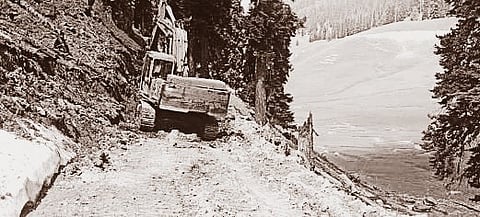
Despite these existing routes, a fourth road, 35 kilometres of which cut through the pristine Rajwar forest, was sanctioned and built. Critics allege the project was never about tourism; it was about money.
“If there were already three roads leading to Bangus valley, what was the need to cut down thousands of green trees in Rajwar forest?” asked Saurabh Sharma, a senior environmental lawyer who has been arguing environmental cases from J&K before the NGT for over a decade. “This is a fair-weather road and gets damaged repeatedly by landslides and soil erosion during rainfall and snowfall. This is a scam. The road was built without any forest clearance initially.”
Work before clearance
Route 4: The fourth route, beginning from Handwara town and running 40 kilometres through Rajwar forest to Bangus, is where the violations began. Of this 5 kilometres pass through karewas (arid, unirrigated land) and 35 kilometres cut through dense forest land.
While construction work began in 2017, forest clearance was not granted until September 2019. This essentially meant a gap of at least two years during which work proceeded without any legal authorisation.
“Under the garb of developing tourism in Bangus some public servants with vested interests planned to build a 35 kms long road from Handwara in spite of the fact that this beautiful valley is already connected with three roads. A fourth road was cut through dense forests of Rajwar area in Handwara, Kupwara,” said Rasikh Rasool Bhat, an activist and lawyer based in Handwara who has been arguing this case before the NGT for over two years.
“The work was illegally taken up in 2017 while official forest clearance was granted in September 2019. Ironically, the compensation amount of more than Rs 3.81 crores was also not paid for 6 years. This amount was paid only after the National Green Tribunal intervened where I had moved an application in 2024,” he said.
Rasikh also flagged illegal mining: “To construct the road a local fresh water stream was plundered and sand and other riverbed material like gravel, bajri, boulders were excavated without any environmental clearance.”
The forest clearance that should have lapsed
Forest Clearance for the project was issued by the Forest, Ecology & Environment Department of the J&K Government through Government Order No. 281-FST of 2019, dated September 24, 2019. The clearance authorised the felling of 1,023 trees and the use of 14 hectares of forest land for Phase 1 of the project.
Crucially, Condition 12 of the clearance order, issued by the then Commissioner Secretary of the Forest, Environment & Ecology Department, Mr. Manoj Kumar Dwivedi, stated:
“The approval will remain valid for one year and in case the due amount against the project summarised above is not paid within the stipulated period, the approval shall be deemed to have been cancelled.”
As per the official documents available with The Leaflet, the approval given by the Forest Department for axing of trees and utilization of forest land should have been cancelled as the Public Works Department (Roads & Buildings) (PWD R&B) failed to pay the required compensation of Rs 3,81,13,360 (approximately Rs 3.81 crore) within one year.
By August 2020, the clearance should legally have been treated as cancelled, and no further construction should have been permitted by the local Division Forest Officer (DFO). It was not until the NGT intervened, following Rasikh Rasool's application in 2024, that the PWD (R&B) finally paid the overdue amount.
Around Rs 50 crore has reportedly been spent on this road, a road that, according to critics, is structurally vulnerable, prone to annual damage from landslides and heavy snowfall, and was never needed in the first place.
Thousands of trees felled, wildlife habitat destroyed
The official clearance permitted the felling of 1,023 trees. Witnesses and activists allege the actual number was ten times higher.
“A large number of fully grown Deodar, Kail, and Fir trees were axed, while only 1,023 trees had clearance to be cut," said Reyan Sofi, a noted Kashmiri wildlife photographer. "Different species of wildlife, including black bears, musk deer, Himalayan goral, and leopards, had their habitat destroyed. Endangered species such as the cheer pheasant, koklass pheasant, and western tragopan were also affected. To this day, authorities have not acted, and even the custodians of J&K's forest and wildlife departments have failed to respond.”
Meanwhile, activists point out that the Government had previously proposed alternatives that would have avoided deforestation altogether.
“In fact the Government, in 2012–13, had planned to connect Bangus valley with a cable car from Reshnari or Watterbala, so as to ensure no trees were axed in the 6 kilometres area and locals of Rajwar area get some livelihood options,” said Rasikh.
“Forest clearance for Handwara-Bangus road project was granted in violation of rules as an alternate route known as Handwara-Zachaldara-Wadder was available and there was no need to propose another route via forests parallel to it. Undoubtedly, such forest clearance was proposed and granted with possible criminal intent on the part of the officials involved as the first 7 kilometres of the project are non-forest land and a great part of it belongs to influential persons. This was done only to mint money from this project and some local politicians were supporting this programme,” he asserted.
The NGT steps in
Following Rasikh's petition, the NGT's Principal Bench headed by Justice Prakash Srivastava (Chairperson) and Dr Senthil Veil (Expert Member) directed the J&K Chief Secretary to submit a comprehensive affidavit explaining how over 1,000 trees, poles, and saplings had been felled in Rajwar forest without compensation, what disciplinary action had been taken against errant officers, and whether such irregularities existed in other projects across J&K, such as illegal riverbed mining in the local stream without any environmental clearance.
The Chief Secretary missed the six-week deadline, filed for an extension, and in his affidavit, placed before the Tribunal on November 11, 2025, tendered an unconditional apology:
“That the applicant humbly and unreservedly tenders an unconditional apology for this delay and lapse, prays for kind consideration and indulgence of this Hon’ble tribunal and assures that utmost care shall be taken with strict compliance of all tribunal directions.” – Affidavit of J&K Chief Secretary, Mr. Atul Duloo
The matter was listed again before the NGT on January 13, 2026. The compliance report submitted by the Chief Secretary made some glaring revelations: across 145 to 154 infrastructure projects, mostly road projects, a total of 82,327 forest trees had been felled without the required compensation being deposited. The total compensatory afforestation liability stands at Rs 80.73 crore, of which Rs 45.33 crore remains unpaid.
A policy decision, not individual misconduct
The Chief Secretary's reply to the NGT, dated December 24, 2025, attributed the pattern of forest diversion without compensation to a policy decision taken by the erstwhile State Administrative Council (SAC), the J&K governing body headed by the then-Governor Satya Pal Malik on July 30, 2019, just days before the abrogation of Article 370.
That SAC decision modified an earlier cabinet resolution, permitting government sanctions for the diversion of forest land for non-forestry purposes even when compensatory levies had not been fully deposited by user agencies. The administration has argued that the move was intended to prevent delays in public infrastructure projects and was applied uniformly across departments.
The Chief Secretary's submission effectively shielded individual officers from accountability, arguing there was no personal lapse or misconduct — only a policy directive from above. The NGT had specifically asked the Chief Secretary to detail what enquiries had been initiated against officials who permitted trees to be felled without compensation.
Calls for a CBI probe
“Had I not taken this issue to the National Green Tribunal, all these things would not have been exposed,” said Rasikh. “For decades, J&K Government has been issuing forest clearance and proper compensation amount was not paid. All these things particularly, the Handwara-Bangus road project, need an in-depth enquiry by the CBI.”
Saurabh Sharma echoed the demand: “Chief Minister Omar Abdullah must order a probe through an independent investigating agency.”
The Leaflet reached out to the Chief Secretary of J&K for comment via email. No response was received.