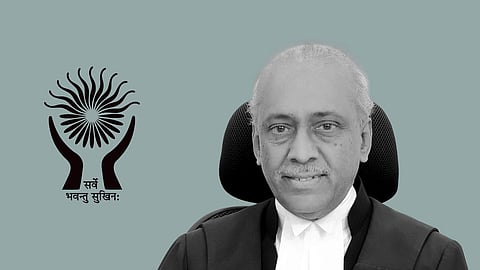

ON Monday, the President of India, Droupadi Murmu, appointed former Supreme Court judge V. Ramasubramanian chairperson of the National Human Rights Commission (NHRC). The office had been vacant since June 1, when Justice Arun Mishra retired as chairperson of the NHRC.
The President of India also appointed chairperson of the National Commission for Protection of Child Rights Priyank Kanoongo and retired high court Chief Justice Bidyut Ranjan Sarangi as members of the NHRC.
Justice Ramasubramanian hails from Tamil Nadu. He was appointed to the Supreme Court on September 23, 2019, and retired on June 29, 2023. He also served as Chief Justice of the Himachal Pradesh High Court before his elevation to the Supreme Court.
The decision to appoint Justice Ramasubramanian to the NHRC was taken on the recommendation of a committee that comprises the Prime Minister as its chairperson, Speaker of Lok Sabha, minister-in-charge of the Union home ministry, leaders of Opposition in Lok Sabha and Rajya Sabha, and deputy chairman of Rajya Sabha.
Of the six members of the committee, two members, namely Rahul Gandhi and Mapanna Mallikarjun Kharge, who are leaders of Opposition in Lok Sabha and Rajya Sabha respectively, gave their common dissent.
They termed the selection process adopted by the committee “fundamentally flawed and a pre-determined exercise that ignored the established tradition of mutual consultation and consensus, which is essential in such matters”.
“This departure undermines the principles of fairness and impartiality, which are critical to the credibility of the selection committee. Instead of fostering deliberation and ensuring a collective decision, the committee relied on its numerical majority to finalise the names, disregarding the legitimate concerns and perspectives raised during the meeting,” read a dissenting note signed by Gandhi and Kharge.
Both Gandhi and Kharge had proposed names of former Supreme Court judges Justice Rohinton Fali Nariman and Justice K.M. Joseph, but a majority of the committee members rejected these names.
“Justice Rohinton Fali Nariman, a distinguished jurist from the minority Parsi community, is renowned for his intellectual depth and unwavering commitment to constitutional values. His inclusion would send a strong message about the NHRC's dedication to representing India's pluralistic society.
“Similarly, Justice Kuttiyil Mathew Joseph, a former Supreme Court judge, belonging to the minority Christian community, has consistently delivered judgments that emphasise individual freedoms and the protection of marginalised groups, making him an ideal candidate for this critical position,” the dissenting note states.
Gandhi and Kharge recommended the names of former Chief Justice of the Orissa High Court Justice S. Muralidhar and former Chief Justice of the Rajasthan High Court Justice Akil Abdulhamid Qureshi for being appointed as members of the NHRC. However, the majority led by Prime Minister Modi shot down the names.
In justification of their dissent, Gandhi and Kharge said while merit is undeniably the primary criterion, maintaining a balance that reflects the regional, caste, community and religious diversity of the nation is equally important.
“The dismissive approach adopted by the majority of the selection committee in today's meeting towards these considerations is deeply regrettable. The NHRC's credibility and effectiveness depend on its ability to embody the diversity and inclusiveness that define India's constitutional ethos,” the dissenting note states.
Kharge, as Leader of Opposition in Rajya Sabha, had also dissociated himself from the selection process held to appoint Justice Arun Mishra as chairperson of the NHRC in 2021. There was no leader of Opposition in Lok Sabha in that Parliament.
The law
The NHRC is constituted under Section 3 of the Protection of Human Rights Act, 1993, which consists of:
A chairperson who has been a Chief Justice of India or a judge of the Supreme Court.
One member who is, or has been, a judge of the Supreme Court.
One member who is, or has been, the Chief Justice of a high court.
Three members, out of which at least one shall be a woman, to be appointed from amongst persons having knowledge of, or practical experience in, matters relating to human rights.
The chairperson of the National Commission for Backward Classes.
The chairperson of the National Commission for Minorities.
The chairperson of the National Commission for the Protection of Child Rights.
The chairperson of the National Commission for the Scheduled Castes.
The chairperson of the National Commission for the Scheduled Tribes.
The chairperson of the National Commission for Women.
The chief commissioner for persons with disabilities
Members at serial no. 5 to 11 are deemed members of the NHRC.
Under the Act, the chairperson is appointed for three years from the date on which they enter upon their office or until they attain the age of seventy years, whichever is earlier and the person so appointed is also eligible for re-appointment.
A person appointed as a member of the NHRC also holds office for three years and is eligible for re-appointment. However, no member can hold office after they have attained the age of seventy years.
Section 12 of the Act lays down the functions of the NHRC which include:
Inquire, suo motu or on a petition presented to it by a victim or any person on his behalf or on a direction or order of any court, into a complaint of a violation of human rights or abetment thereof; or negligence in the prevention of such violation, by a public servant;
Intervene in any proceeding involving any allegation of violation of human rights pending before a court with the approval of such court;
Visit, notwithstanding anything contained in any other law for the time being in force, any jail or other institution under the control of the state government, where persons are detained or lodged for purposes of treatment, reformation or protection, for the study of the living conditions of the inmates thereof and make recommendations thereon to the government;
Review the safeguards provided by or under the Constitution or any law for the time being in force for the protection of human rights and recommend measures for their effective implementation;
Review the factors, including acts of terrorism, that inhibit the enjoyment of human rights and recommend appropriate remedial measures;
Study treaties and other international instruments on human rights and make recommendations for their effective implementation;
Undertake and promote research in the field of human rights;
Spread human rights literacy among various sections of society and promote awareness of the safeguards available for the protection of these rights through publications, the media, seminars and other available means;
Encourage the efforts of non-governmental organisations and institutions working in the field of human rights;
Such other functions as it may consider necessary for the promotion of human rights.
