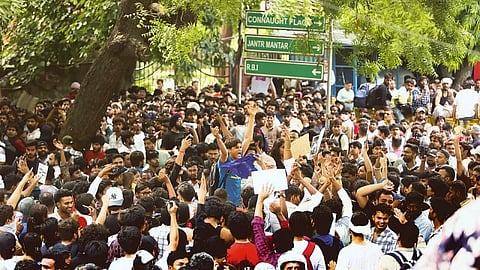

ON TUESDAY, the Supreme Court observed that a prima facie case had been made out for an independent investigation into allegations of police excesses against students who had gathered to demand the resignation of Dharmendra Pradhan as the Union Education Minister.
A three-judge Bench comprising Chief Justice of India Surya Kant and Justices Joymalya Bagchi and V. Mohana also issued notices to the Delhi government and the states of Madhya Pradesh, Kerala, Bihar, Assam, Maharashtra and West Bengal, seeking their replies to a batch of petitions highlighting police excesses against students.
The Bench is likely to constitute a High-Powered Committee (‘HPC’) or a Special Investigation Team (‘SIT’) to probe the allegations of police excesses.
“The allegations made by the petitioners, prima facie, establish a compelling case for an independent and impartial investigation into the incidents of violence. Such an investigation will adequately address the allegations presented by the family members of the police personnel, as well as the issues raised by the learned Solicitor General of India,” the Bench noted.
‘No coercive measures shall be taken against the students’: Supreme Court
As an interim measure, the Bench directed that no coercive action be taken against the protesting, except those with criminal antecedents. It further directed that all minors detained in connection with the protests be released, if necessary upon execution of a simple bond.
“The NCT of Delhi and other States may proceed with the investigation of the FIRs registered; however, no coercive measures shall be taken against the protesting students. Such protection, nonetheless, shall not be extended to the persons with criminal antecedents,” the Bench ordered.
It added, “All States are hereby instructed to release children under the age of 18, who have been reported to be arrested or detained in connection with the ongoing protests and who do not possess any criminal antecedents. If necessary, these children shall be released upon the execution of a simple bond by themselves or their family members, especially if such a requirement is insisted upon for surety.”
The Bench also directed the police to ensure that all CCTV footage, drone camera recordings, PCR logs and other digital evidence are duly preserved, and ordered that no personal data of the protesters be published.
A battery of lawyers, including senior advocates Gopal Sankaranarayanan, Shyam Divan, Abhishek Manu Singhvi, Shadan Farasat, Shoeb Alam and N. Hariharan, along with advocates Prashant Bhushan and Vrinda Grover, appeared seeking a probe into the alleged police excesses.
The Bench noted that the nature of the incidents detailed in petitions suggests that:
(i) Pellet guns were used that led to injuries to the young students, including one boy allegedly losing his eyesight;
(ii) Rubber bullets were used that caused injuries to various persons, including a woman.
(iii) Electronic batons were used to disperse the crowd.
(iv) Lathis embedded with nails were also used resulting in permanent injury and life-threatening injuries to some of the protestors.
(v) Even a member of the media was assaulted, leading to the individual sustaining serious injuries
It further noted that the violence allegedly was also perpetrated by police personnel in police and civilian dress, among other instances.
‘Students themselves would not attack the police’: Solicitor General
Appearing for the Union Government and the Delhi government, Solicitor General Tushar Mehta submitted that as many as 280 police personnel were injured during the protests. He clarified, however, that any police personnel found to have used excesses against students could not be let off and that the law would take its own course.
Mehta submitted that students themselves would not attack the police and that anti-social elements who joined the gathering might have been responsible. He did not oppose an SIT probe, stating that it was for the Court to decide who should head it, after the petitioners’ side handed over names of some former Chief Justices of India for consideration. Mehta added that he didn’t want a scene in which names of retired judges are suggested only to be opposed by the petitioners (and vice versa), and thus preferred to leave it to the Court, in its discretion, to decide who should head the probe.
‘Fix accountability for those who used force against students’: Petitioners
Senior advocate Sankaranarayanan highlighted specific instances of police excesses from his petition. He submitted that the police had not followed the laid-down protocol and urged the Court to fix accountability for those who used force against students. He also pointed out that some protesters were receiving notices after being identified through facial recognition technology.
Senior advocate Divan brought to the Bench’s notice incidents of excesses, including how police in Maharashtra allegedly threatened students with planting drugs on them.
Senior advocate Farasat highlighted the detention of many minors in Bihar. While Advocate Prashant Bhushan drew attention to the case of Junaid Malik, who was helping protesters with food at Jantar Mantar, was picked up by Delhi Police, taken blindfolded to Uttarakhand and left there.
Senior advocate Shoeb Alam drew the Court’s attention to the use of AK-47s against unarmed students in Bihar.
Advocate Vrinda Grover raised the use of pellet guns and noted that a truck full of stones had been parked at Jantar Mantar, questioning how it reached there. She urged the Court to direct the preservation of case diaries that would show the use of pellets and the authorities who approved them.
The matter will now be heard on August 3, when the Bench is likely to constitute a High-Powered Committee to probe the allegations.
Brief background
The protests originated from widespread outrage over repeated examination paper leaks, particularly the NEET-UG 2026 paper leak. The protest was spearheaded by the Cockroach Janata Party (‘CJP’), which came into existence after Chief Justice Surya Kant compared unemployed youth to “cockroaches” and “parasites.” The Chief Justice later clarified that his remark was in the context of those lawyers who have fake degrees.
Students from all over India sat on dharna for weeks at Delhi’s Jantar Mantar. On July 20, the CJP organised a “Sansad Chalo” march towards Parliament, the day when incidents of police excesses against students were reported.
A day before the scheduled march, well-known social activist and educator Sonam Wangchuk, who had been on an indefinite hunger strike in solidarity since late June, was picked up by the Special Staff and the Delhi Police and admitted to Safdarjung Hospital.
The agitation ended after Pradhan resigned on July 25. Two Union Ministers subsequently assured the CJP that cases against protesting students would be withdrawn. States, such as Bihar and Assam, later announced steps to drop FIRs and release detainees.