
At The Leaflet, our most leading concern has always been the health of our constitutional polity – one moving into, changing within a rapidly growing world, but one that is to be rooted, grounded in human rights. Technology and particularly the internet, long ago, permeated substantive elements of our existence, and is today, also, a substantive regulatory concern for our governments – in that sense, the law and legal regimes have been discussed in the context of adapting to innovation, and opening up the space for these transformations – even the ones whose impact on humanity we are yet to fully grasp, like artificial intelligence. The law is also to be discussed in terms of its role in being used, abused and misused to further the ends of digital authoritarianism – which in our country remains a growing concern with India evolving one of the world’s most intricate frameworks for digital censorship in the past few years from within the regime of the IT Act.
Legal and political design will mediate technology’s direction as it rapidly innovates and fundamentally alters our realities. There is a growing sense for the need of dedicated, rigorous scholarship on law and technology that brings together technical know-how and industry challenges, but with a deep sense of what the larger public interest demands. As our courts move more increasingly towards integration with technology, what digital policies must guide this evolution of access to justice? As AI evolves increasingly, seeping into our everyday life, and into the lives, also, of lawyers – in chambers, in corporate law offices and everywhere else – with the slow emergence of a formal industry of AI legal assistance tools, it is important to pause and ask what turns these transformations will take. Understanding these technical revolutions with all their nuances, and thinking deeply about the regulatory regimes around them – not simply to usher in these changes, but also in the interest of the rights of our citizens - their privacy, their freedom of speech on the internet, their right not to be discriminated in the age of algorithmic discrimination - is fundamentally important.
This column will be a humble attempt to bring together expert commentary from diverse aspects of law and technology, in a way that innovates our pursuit of scientific temperament, but by rooting everything into the rights-based, moral foundations of our constitution.
Warmly,
Sushovan Patnaik,
Associate Editor
The Leaflet
---------------------------------------------------------------------------------------------------------------------------
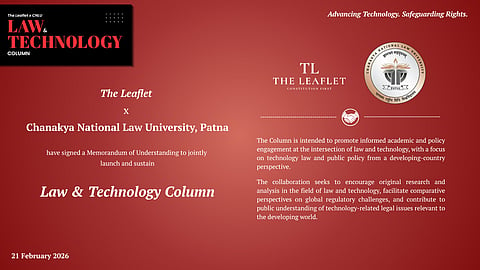
The Law and Technology Column, developed in collaboration with The Leaflet and Chanakya National Law University (CNLU), represents a significant academic–industry initiative focused on the intersection of law and emerging technologies. This platform facilitates engagement between legal scholarship and public discourse by presenting complex technological and legal and ethical issues in an accessible manner to a wider audience.
The column explores critical themes such as artificial intelligence governance, data protection, cybersecurity, platform accountability, and digital rights. These topics are examined within both Indian and global regulatory frameworks, providing insights into the necessary evolution of legal systems in response to rapid technological change.
A key strength of this initiative lies in its interdisciplinary and policy-oriented approach. By combining academic rigour with journalistic outreach, the column not only contributes to scholarly debates but also informs policymakers, practitioners, and the general public. It plays a crucial role in promoting awareness about legal and ethical concerns, including algorithmic bias, surveillance, and the protection of fundamental rights in the digital age.
Overall, the collaboration between The Leaflet and CNLU in curating the Law and Technology Column underscores the importance of institutional partnerships in promoting informed, inclusive, and forward-looking discourse on technology regulation.
Dr. Sadaf Fahim,
Assistant Professor of Law,
Chanakya National Law University, Patna
---------------------------------------------------------------------------------------------------------------------------
