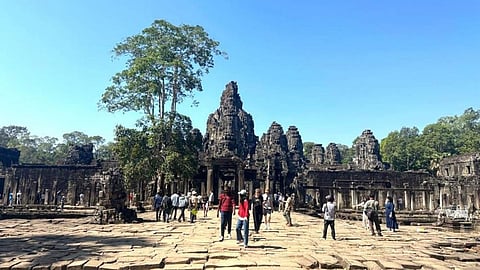

A visit to Cambodia during the Christmas holidays by the team of lawyers under the aegis of the Bar Association of India— hosted by the Cambodia Bar Association— was a refreshing break for the litigating warriors.
Even though traveling was definitely for tourism, it has its way of enhancing knowledge of law through interdisciplinary exploration, especially looking at the cultural history of a nation that connects with our own country.
We explored the impact of the Indic philosophy on the Khmer dynasty, the history of the constitutionalisation of Cambodia, and the relevance of the Mekong to international water conflicts which are erupting more due to the threat of climate change.
Indic philosophy invaded Cambodia
Cambodia’s tryst with Indic philosophy has been attracting huge interest, particularly due to the architectural beauty of temples, though these temples are not places of worship anymore.
Indic philosophy of life and religion traveled to East Asia in the Middle Ages with trading traders from South India. The then Khmer dynasty of Cambodia embraced the Brahminical religion, now popularly known as Hinduism and endeared to Indic philosophy by promoting its art and culture.
The dynasty apparently sought to justify its legitimacy by relying on a religious theory that the king is an avatar of Vishnu; one of three avatars of Ishwar in theistic Indic philosophy.
On embracing Hinduism, the Khmer regime in Cambodia developed places of worship with great passion from the ninth century onwards. The Siem Province— a seat of Khmer rulers— became the place for magnificent temples.
