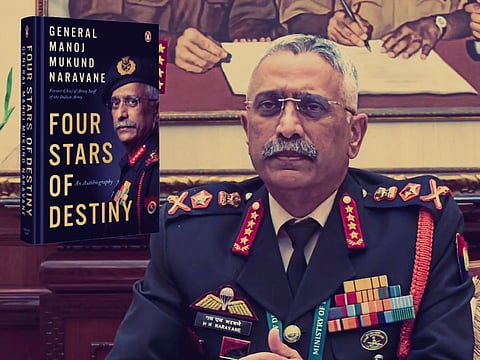
General Naravane Memoir Row: Understanding Rule 349(i) of Lok Sabha's Rules of Procedure

A Lok Sabha face-off over excerpts from General M.M. Naravane’s memoir has renewed debate on Rule 349(i) and the limits of what can be cited in Parliament.
General Naravane Memoir Row: Understanding Rule 349(i) of Lok Sabha's Rules of Procedure
Published on

LAST WEEK, a discussion in the Parliament brought Rule 349(i) of the Rules of Procedure and Conduct of Business in Lok Sabha (‘the Rules’) into sharp focus. Leader of the Opposition Rahul Gandhi attempted to read excerpts from former Chief of Army Staff General M.M. Naravane’s memoir ‘Four Stars of Destiny’ during a Lok Sabha debate on the Motion of Thanks to the President's Address. The incident led to disruptions, subsequent suspensions of eight Members of Parliament (‘MPs’) from the opposition and renewed debate about what materials can be cited in Parliament.

While a member must take responsibility for the veracity of their sources, the Speaker of the House holds the final prerogative on whether to allow such statements.

How the dispute unfolded

Gandhi sought to reference excerpts from General Naravane's memoir that had been published by The Caravan magazine in January. The excerpts detailed the tense 2020 India-China border standoff at Kailash Range, Ladakh. It notes that on August 31, 2020, as Chinese tanks advanced at Rechin La and frantic attempts were made to obtain clear instructions from the government, General Naravane received a vague response from Prime Minister Narendra Modi, “jo uchit samjho woh karo” (“do whatever you think is appropriate”). The lack of clear direction, Naravane writes, left him holding a “hot potato.”

As Gandhi began to read out the excerpt, BJP members immediately raised procedural objections, questioning whether ‘unpublished’ material could be quoted in the House and whether the material had been properly verified. BJP MP Nishikant Dubey invoked Rule 349(i), arguing that it prohibited reading from books or newspapers in the manner attempted.

General Naravane Memoir Row: Understanding Rule 349(i) of Lok Sabha's Rules of Procedure
Why opposition must be vigilant as Om Birla begins second term as Speaker

The Speaker noted that under Rule 349(i) unpublished material could not be quoted and emphasized that even published books or articles must comply with parliamentary procedure. Another rule referenced during the debate was Rule 353. This rule addresses situations where an MP makes allegations of a ‘defamatory or incriminatory nature’ against an individual. Under Rule 353, MPs must provide advance notice of such allegations to the Speaker and the concerned member, allowing the concerned member time to verify facts and prepare a response.

Meanwhile, General Naravane has publicly stated that his book remains under review by the Ministry of Defence and has not received official clearance for publication. While speaking at the Khushwant Singh Literature Festival in October last year, he confirmed: “My job was to write the book and give it to the publishers. It was the publishers who were to get the permission from the MoD. They gave it to them. It is under review. It is still under review for more than a year now.”

The book, which was scheduled for publication by Penguin in April 2024 and had been listed for pre-order on Amazon and Flipkart, was either unavailable or could not be found hours after Rahul Gandhi displayed a copy in the Lok Sabha and quoted from it.

While a member must take responsibility for the veracity of their sources, the Speaker of the House holds the final prerogative on whether to allow such statements.

According to a Right to Information response obtained by The Indian Express, over the five-year period from 2020 to 2024, General Naravane’s book is the only manuscript that remains pending clearance by the Ministry, even as dozens of other manuscripts have passed through the process and received approval. 

What is Rule 349(i)?

Rule 349(i) appears in Chapter XXVII of the Rules, which governs member conduct. The rule states: "Whilst the House is sitting, a member — (i) shall not read any book, newspaper or letter except in connection with the business of the House."

Critically, this rule does not impose an absolute ban on reading such materials. Rather, it creates a conditional restriction making reading permissible if the material relates to the business of the House. The rule applies to all members regardless of position.

The rule serves several important functions. First, it keeps parliamentary discussions centered on scheduled business rather than allowing tangential matters to derail proceedings. Second, it ensures accountability, as parliamentary statements carry legal and political weight. By restricting readings to relevant material, the rule ensures that statements can be properly questioned, examined, and answered. Third, it creates a framework where the sources of information cited in Parliament can be scrutinized for accuracy and authenticity.

Notably, the Rules contain no explicit provision regarding the quotation of unpublished books. They neither expressly prohibit nor explicitly permit such citations. Consequently, Parliament has developed conventions rather than codified rules to handle this grey area.

Unpublished material is generally treated with greater caution than published works already in public circulation. When MPs quote unpublished material, the Speaker typically requests clarification regarding the source of the material, its reliability and authenticity, and whether it can be independently verified. This heightened scrutiny holds MPs accountable for the credibility of materials they cite. 

The question of relevance

The key to applying Rule 349(1) is relevance. In an interview for India Today, Former Secretary General of the Lok Sabha P.D.T. Achary explained that MPs may quote written material if it directly relates to the subject before the House and contributes meaningfully to the discussion. “He has to merely say that I am authenticating it because I have verified the truth contained in this, and I stand by that,” he noted. According to Achary, under Rule 349, members are allowed to quote from books or articles when they relate to the ‘business of the House’.

General Naravane Memoir Row: Understanding Rule 349(i) of Lok Sabha's Rules of Procedure
Resolution of India – China Border Dispute over Ladakh is the need of the hour

In practice, the Speaker determines relevance by considering the issue under discussion, the nature of the material being cited and whether the reference adds substantive value to the debate. While a member must take responsibility for the veracity of their sources, the Speaker of the House holds the final prerogative on whether to allow such statements.

The debate on the President's Address holds unique significance in parliamentary practice. Along with Budget debates, it permits the broadest scope for discussion in the Lok Sabha. During this debate, MPs are not confined to points mentioned in the President's speech but may raise broader issues concerning government policy, national concerns and the country's overall condition. This traditional latitude gives MPs greater freedom in subject selection, though procedural rules still apply.

We're bringing The Leaflet closer to you! Join thousands of readers on our new WhatsApp and Telegram channels. Stay informed, stay connected.

WhatsApp

Telegram

Related Stories

No stories found.
The Leaflet
theleaflet.in