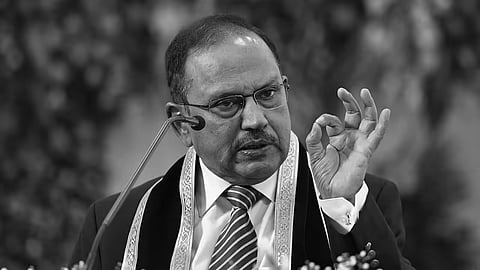

WHILE RECEIVING the Lokmanya Tilak National Award in Pune in recognition of his contribution to strengthening India’s National Security Advisor Ajit Doval urged the younger generation to be mindful that freedom should not be understood merely as the liberty to do whatever one desires. To drive home the point he appealed to the youth to dedicate themselves to serve the nation and flagged that the freedom they enjoyed is very precious in contrast to the colonial era when Lokmanya Tilak struggled and faced hardships which the present generation in India would hardly imagine. “Every Indian, especially our youth, needs to reflect on his words, consider the vision he held for India and the spirit of nation-building he embodied,” Doval remarked.
He proceeded to add,“Young people today might assume that India has always been the way it is now, or they might mistake freedom for the mere liberty to do whatever one desires. But that is not what freedom truly means.”
‘Civil society new frontier of war’: Doval
Like his 2021 statement, at a passing-out ceremony of IPS officers in Hyderabad, that civil society is the “new frontier of war”, his 2026 remark that youth should not interpret freedom for the mere liberty has caused consternation among liberal-minded people.
Earlier in 2021, he had commented that “the new frontier of war, what you call the fourth-generation warfare, is civil society... that can be… manipulated to hurt the interest of a nation,” and had urged police officers to perform their duties so that the land of India is fully protected.
He was widely criticised and charged that his statement would mean crushing dissent and demolish the police officers’ duty to remain committed to the Constitution, making them pliable instruments of the party in power.
The Constitutional Conduct Group, which consists of distinguished civil servants and diplomats, in a statement had regretted that “instead of exhorting the IPS probationers to abide by the values enshrined in the Constitution to which they had sworn allegiance, the NSA stressed the primacy of the representatives of the people, and the laws framed by them.”
A former Intelligence Bureau director said that Doval’s statement was “shocking” and unbecoming of a National Security Adviser. He remarked that Doval “…in effect, asking trainee IPS officers to act against civil society groups and crush dissent. He seems to have forgotten that India is still a democracy and not a police state.”
Criticism of Doval’s remarks
Five years later, his statement, while receiving the Lokmanya Tilak award, that the younger generation should not see freedom they have as the liberty to do whatever one desires has caused worry and anxieties in the context of the students’ protest at Jantar Mantar. The protests against the rotten education and examination system forced the Union Education Minister Dharmendra Pradhan to resign.
NDTV, which is owned by Gautam Adani and hardly interrogates the Modi regime, published a piece, “Youth May Mistake Freedom for Liberty to Do What One Wants: Ajit Doval” in which it is remarked, “Doval’s warning in Pune that contemporary young people risk misinterpreting freedom as the mere liberty to act without restraint arrives directly on the heels of unprecedented youth-led demonstrations against Prime Minister Narendra Modi’s administration.”
It went on to critically remark, “While student protesters argue that true democratic freedom includes structural accountability, transparency, and the right to challenge state apparatuses head-on, senior security and government figures like Doval emphasised that societal stability, national building, and adherence to established state frameworks must take precedence over unrestrained defiance.”
Those critical remarks assume seminal significance particularly in the context of Doval invoking Tilak and urging youth of our country to follow his legacy and serve the nation.
Tilak’s invaluable legacy as a protestor
Doval should have been mindful of the fact that Lokmanya Tilak was an exemplary protestor and was described as the ‘Father of Indian Unrest’ for his role for India’s freedom. He was slapped with sedition charges and spent years in prison after his conviction. It is indeed tragic that during the last twelve years after Modi became the Prime Minister, a record number of people have been slapped with sedition charges for criticising the Government. Article 14 in a February 2021 study revealed that sedition cases over the last decade rose by 28 percent, in violation of Supreme Court guidelines, especially against critics and protesters since 2014.
Arvind Datar in his 2020 article, ‘On Tilak’s hundredth death anniversary, what governments can learn from his two trials’, which was published in the Indian Express, referred to Tilak’s eighteen months imprisonment for criticising the British regime and quoted a British newspaper which remarked that “..there was hardly any evidence that would justify such a severe sentence,” and observed that if criticism was to be punished as sedition, “the government is on a perilous path”.
Those words are playing out in India today, and it would have been salutary if Doval had been mindful of Tilak’s suffering as a protestor and of how people agitating on genuine issues in India are now dismissed by Modi himself as “andolan jeevis.” Such treatment of protestors is a negation of Tilak’s legacy.
Datar in his article wrote, “The partition of Bengal and the killing of two English women by a bomb hurled by Khudiram Bose led to large-scale repression. The Anglo-Indian press attacked Tilak for provoking the youth to engage in violent protests. Once again, Tilak wrote several articles in Kesari and asked the government to stop repressing freedom. He pointed out that the best way to stop violence and bombs was to grant self-rule to the people of India…”
In 1908, Tilak faced a second trial on sedition on the ground that he was consulting two books on explosives for manufacturing bombs and his articles on explosives encouraged others to use bombs against British authorities. Tilak’s arguments in the court were that for writing an article on the Explosives Act he had written the titles of two books on explosives on a piece of paper and it had nothing to do with making bombs. That defence plea fell on deaf ears and he was convicted for sedition and sentenced to imprisonment for six years.
Tilak’s arrest and imprisonment never could diminish the intensity of the freedom struggle which subsequently engulfed the whole country. “The two trials,” Datar wrote, “teach us useful lessons in dealing with public protests.” “A wise government would do well to ascertain the opposite viewpoint and have the grace to correct its path wherever necessary. Suppressing widespread dissent or criticism has always proved counterproductive,” he thoughtfully suggested.
All in all, Doval’s remarks that youth should not understand freedom as liberty to whatever they want to do is not consistent with Tilak’s legacy which is now reflected in peaceful protests of students across India for quality education and integrity of the examination system.
