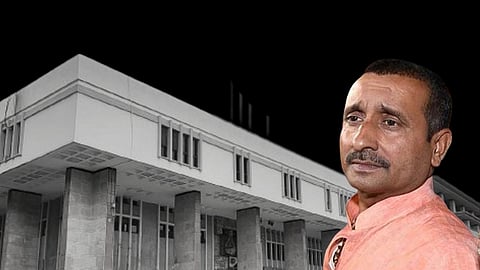

ON DECEMBER 29, a three-judge bench of the Supreme Court, comprising Chief Justice Surya Kant and Justices J.K. Maheshwari and A.G. Masih, heard the appeal filed against the Delhi High Court’s (‘HC’) judgment in Kuldeep Singh Sengar v. CBI (2025) by the Central Bureau of Investigation (‘CBI’) and Advocate Anjale Patel.
The HC’s judgement suspended the life sentence of expelled-BJP leader Kuldeep Singh Sengar, who was convicted by the trial court in the infamous Unnao rape case. It held that a sitting Member of the Legislative Assembly (‘MLA’) does not fall within the definition of a “public servant” under Section 21 of the Indian Penal Code, 1860 (‘IPC’). On this basis, the HC concluded that Section 5(c) of the Protection of Children from Sexual Offences Act, 2012 (‘POCSO Act’), which classifies sexual assault by a public servant as an aggravated offence, was inapplicable. The decision drew sharp criticism from lawyers, senior advocates, politicians, and the survivor’s family, triggering public protests.
While staying the HC’s order, the Supreme Court observed that the appeal raised several substantial questions of law and expressed concern over the exclusion of elected MLAs from the definition of a “public servant.”
In this post, the author examines the Delhi HC’s suspension of sentence through the lens of the Supreme Court’s settled jurisprudence under Section 389 of the Code of Criminal Procedure, 1973 (‘CrPC’). The HC judgement, it is argued, reflects a perilous turn to judicial formalism, where a hyper-technical reading of Section 21 IPC displaced the post-conviction presumption of guilt and produced a de facto acquittal on the aggravated charge.
A brief timeline
The present case arises from allegations of the sexual assault of a minor girl (“the survivor”) in June 2017 in Unnao, Uttar Pradesh, by Kuldeep Singh Sengar, then a sitting MLA. The prosecution alleged that the survivor was lured to Sengar’s residence and raped. The assault was not immediately reported, allegedly due to threats and intimidation. Following inaction by the local police, the survivor’s mother moved an application under Section 156(3) CrPC before the Special Court (POCSO), Unnao, on February 12, 2018, alleging offences under Sections 363, 366, 376, and 506 IPC, as well as under the POCSO Act.
The trajectory of the case shifted tragically in April 2018 when the survivor’s father, after allegedly being assaulted by Sengar’s associates and arrested on fabricated charges, died in judicial custody. This development led to the transfer of the investigation to the CBI. In August 2019, citing threats to the survivor and administrative delays, the Supreme Court took suo motu cognisance of the matter and transferred the trial to the Tis Hazari Courts in Delhi. The Trial Court framed charges under Section 5(c) of the POCSO Act, recognising Sengar as a “public servant” and thereby invoking the aggravated penetrative sexual assault provision.
In December 2019, Sengar was convicted under Section 376 IPC and Sections 5(c) and 6 of the POCSO Act, and sentenced to imprisonment for the remainder of his natural life. Aggrieved by the conviction and sentence, he preferred a statutory appeal before the Delhi HC, during the pendency of which the present proceedings arose.
The High Court’s approach
The Delhi HC reiterated that while considering an application under Section 389 CrPC, it was not expected to finally adjudicate the appeal or undertake a detailed re-appreciation of evidence. However, it was required to examine whether the conviction rested on prima facie sustainable legal foundations, whether the sentence imposed was arguably excessive, and whether continued incarceration would render the appeal nugatory. The HC therefore confined itself to examining the legal sustainability of the aggravated offence under the POCSO Act, rather than engaging in factual re-determination.
The HC identified the central legal infirmity in the conviction under Sections 5(c) and 6 of the POCSO Act. It noted that the POCSO Act does not define the term “public servant” and that Section 2(2) expressly mandates that undefined terms must derive meaning only from the IPC, the CrPC, the Juvenile Justice (Care and Protection of Children) Act, 2015 or the Information Technology Act, 2000. Among these statutes, the definition of “public servant” exists only in Section 21 IPC. On a plain reading of Section 21 IPC, it observed that a Member of the MLA was conspicuously absent from the enumerated categories of public servants. Consequently, importing any external or purposive meaning would violate the express legislative scheme of Section 2(2) under the POCSO Act.
Relying heavily on the Constitution Bench judgment in A.R. Antulay v. Ramdas Sriniwas Nayak (1984), it noted that the Supreme Court had categorically held that an MLA is not a public servant within the meaning of Section 21 IPC. The Delhi HC reproduced and relied upon the Supreme Court’s authoritative conclusion that “an MLA is not a public servant within the meaning of the expression in Section 21 IPC.” It further held that the Trial Court had committed a prima facie legal error by relying on L.K. Advani v. CBI (1997) and the definition of “public servant” under the Prevention of Corruption Act, 1988 (‘PC Act’). Such reliance was impermissible, it held, since Section 2(2) of the POCSO Act does not include the PC Act. It emphasised that once Parliament had consciously limited interpretive sources, courts could not expand them through judicial creativity at the cost of penal consequences.
Accordingly, it concluded that Sengar could not prima facie fall within Section 5(c) POCSO, and that the statutory foundation for punishment under Section 6 POCSO therefore stood seriously undermined. This conclusion also extended to the aggravated rape provision under Section 376(2)(b) IPC, which rested on the same flawed assumption.
The HC also addressed the victim’s contention that even if Section 5(c) failed, Sengar could still be subjected to aggravated punishment under Section 5(p) POCSO or Sections 376(2)(f) and (k) IPC. It rejected this submission on the ground that an application for the addition of charges under Sections 376(2)(f) and (k) IPC had already been specifically rejected by the Trial Court by a reasoned order in 2019, which had attained finality. It noted that this order was never challenged by the survivor or by the CBI. At the stage of suspension of sentence, it held, it was impermissible to indirectly revive rejected charges.
Given the prima facie unsustainability of the aggravated charge under Section 6 of the POCSO Act, it held that the conviction effectively stood diluted to an offence under Section 3 (simple penetrative sexual assault) and the corresponding IPC provisions, pending final adjudication. This dilution had a direct bearing on the proportionality of the sentence, since Section 6 prescribes a mandatory minimum of twenty years, extending to life imprisonment. It attached substantial weight to the fact that Sengar had already undergone more than eight years of incarceration by the time the application was considered. It noted that continued incarceration, particularly when the aggravated statutory basis itself was prima facie doubtful, would risk rendering the appeal illusory. It further noted that on multiple occasions when interim suspension had been granted earlier, Sengar had not misused liberty, thereby mitigating concerns relating to conduct or flight risk.
Presumption of guilt and the ‘palpable error’ standard
The Supreme Court’s jurisprudence under Section 389 CrPC has evolved as a doctrine of structured and constrained appellate discretion, grounded in a clear distinction between pre-conviction liberty and post-conviction restraint. Suspension of sentence has consistently been treated not as a continuation of bail, but as an exceptional power, exercisable only upon demonstrable legal justification. The controlling formulation was articulated in Omprakash Sahni v. Jai Shankar Chaudhary (2023), where it was held that suspension of sentence requires “something apparent or gross on the face of the record” to enable a prima facie satisfaction that “the conviction may not be sustainable.” It cautioned that the appellate court “should not re-appreciate the evidence” or attempt to identify “a few lacunas or loopholes” at the Section 389 stage. This threshold requirement has remained the jurisprudential anchor across subsequent decisions.
The standard assumes heightened rigour where the sentence imposed is life imprisonment. In Chhotelal Yadav v. State of Jharkhand (2025), the Supreme Court set aside a cryptic suspension order, holding that the HC must indicate the nature of the evidence, the role attributed to the accused, and the legal basis of conviction before exercising discretion. It emphasised that suspension of a life sentence requires demonstration of a “very palpable” or “very gross” error in the impugned judgment. A similar insistence on recorded reasons informed the Court’s interference in CBI v. Rajendra Sadashiv Nikalje (Chhota Rajan) (2025), where suspension of sentence in an organised crime case was held to be legally unsustainable.
The Court has also repeatedly disallowed reliance on irrelevant considerations. In Rajesh Upadhyay v. State of Bihar (2025), suspension based on delay in forwarding the FIR and non-production of the inquest report was rejected as legally untenable, since these factors had “no bearing on the credibility of the prosecution case,” which had already been accepted by the Trial Court. Minimising the accused’s role as one of “instigation” was further held impermissible where the conviction rested on Section 149 IPC.
A distinct, though carefully delimited, strand of jurisprudence addresses long incarceration and appellate delay, anchored in Article 21. In Saudan Singh v. State of Uttar Pradesh (2022), it was recognised that convicts who had undergone more than ten years of custody, with no likelihood of early hearing, could be considered for suspension unless extenuating circumstances existed. This approach was echoed in Aasif @ Pasha v. State of Uttar Pradesh (2025), which acknowledged that continued incarceration pending appeal may render the appellate remedy illusory. At the same time, the Court has been clear that length of custody is not a standalone ground, particularly in cases involving life imprisonment. In Mohammad Arif v. State of Uttar Pradesh (2025), suspension was declined despite nearly ten years of incarceration in a double murder case involving direct firearm use. It was observed that suspension of a life sentence is not automatic, and that Article 21 concerns may instead be addressed through expeditious hearing rather than release.
In cases under the POCSO Act and other sexual offences, the Court has adopted an even stricter approach. In Jamnalal v. State of Rajasthan (2025), suspension granted on the absence of medical corroboration or DNA evidence was set aside, reiterating that Section 389 requires an assessment of whether the record prima facie suggests the likelihood of acquittal, not selective doubt-casting. This principle was reinforced in Lilaben v. State of Gujarat (2025), where it was held that casting doubt on the victim’s age (a finding concluded at trial) was impermissible at the suspension stage, and that until reversed in appeal, such findings constitute the “position in law.” Suspension in POCSO cases, the Court reiterated, remains an exception guided by statutory gravity and societal interest, though a principled distinction has been maintained in cases involving fixed-term sentences.
The perils of interim finality
The Delhi HC’s order, when tested against the rigorous standards laid down in Supreme Court jurisprudence, reveals a series of doctrinal departures that cumulatively weaken its legal sustainability. While the HC correctly prefaced its analysis by acknowledging the limited scope of Section 389 CrPC, its substantive reasoning travelled beyond the permissible contours delineated by the apex court. The most consequential deviation lies in its treatment of the requirement of a prima facie infirmity.
As held in Omprakash Sahni, suspension of sentence must be founded on the identification of a “gross” or “palpable” error rendering the conviction arguably unsustainable. In the present case, however, the HC’s conclusion that the aggravated offence under Section 6 of the POCSO Act was prima facie inapplicable rested not on an infirmity intrinsic to the trial record, but on a fresh interpretive reassessment of the appellant’s statutory status as a “public servant.” This approach effectively transformed the Section 389 inquiry into a preliminary adjudication of the appeal, contrary to the Supreme Court’s repeated caution that suspension proceedings must not assume the character of a merits determination.
Closely connected to this procedural overreach is the HC’s functional re-evaluation of the statutory basis of the conviction, resulting in a de facto dilution of the offence from Section 6 to Section 3 of the POCSO Act. Although framed as a prima facie exercise, this reasoning operated at a depth that the Supreme Court has consistently reserved for final appellate adjudication under Section 374 CrPC. As held in Lilaben, until set aside in appeal, trial court findings, particularly those foundational to statutory gravity, must be treated as the operative legal position. By permitting a statutory downgrading of the offence at the suspension stage, the HC blurred the carefully maintained boundary between interim relief and appellate correction and effectively settled an appeal-defining question without the rigour of a final hearing.
Further, the HC’s reliance on the length of incarceration already undergone reflects a doctrinal slippage in the application of Article 21 in cases involving heinous crimes. While prolonged custody is a relevant consideration, the Supreme Court has consistently clarified that it is facilitative rather than determinative, especially where the sentence imposed is life imprisonment. In Saudan Singh, the Court emphasised that release is not automatic, a principle reinforced in Mohammad Arif, where suspension was declined despite nearly ten years of incarceration on the ground that the gravity of the offence cannot be neutralised by custody alone. By contrast, the HC accorded the appellant’s eight-year incarceration disproportionate normative weight without adequately reconciling it with the statutory seriousness of the offence as recorded by the Trial Court.
The HC’s reasoning also reflects an under-articulation of societal and victim-centric considerations that are integral to the Section 389 balance. As underscored in Jamnalal, the legitimate public aspirations for justice in sexual offence cases necessitate a heightened threshold for suspension, where relief is an exception justified only by compelling reasons. The HC’s reliance on the appellant’s prior compliance with interim bail conditions falls short of this standard, particularly in light of the Supreme Court’s observation that the absence of misuse of liberty is not of much significance at the post-conviction stage. Additionally, by treating the Trial Court’s rejection of other aggravating charges as a factor supporting suspension, the HC indirectly reopened issues that had attained procedural finality. This approach is at odds with Chhotelal Yadav, which confines appellate scrutiny to the framework of the conviction actually recorded.
Drawing the boundaries of “public servant”
The Delhi HC’s reliance on A.R. Antulay to exclude MLAs from the ambit of “public servant” under the POCSO Act reflects a formalistic contraction of accountability that sits uneasily with the structural realities of power. By tethering the definition of a public servant rigidly to Section 21 IPC, the HC has effectively insulated elected representatives from the enhanced penal scrutiny the Parliament envisaged for aggravated sexual offences.
The reconfiguration of Sengar’s conviction under the POCSO Act from Section 6 (aggravated penetrative sexual assault) to Section 3 (sexual assault) produces a normative paradox. A government clerk or even a stamp vendor (a fact noted by the Chief Justice during the hearing) attracts aggravated liability under Section 5(c) of the POCSO Act, while an elected legislator wielding exponentially greater capacity to intimidate, silence, or manipulate institutional processes is shielded from it. This mechanical transposition of the Antulay ratio rendered in the distinct context of the PC Act fails to interrogate the specific mischief the POCSO Act seeks to remedy. Unlike corruption statutes which protect the public exchequer, POCSO is designed to protect vulnerable children from abuse by those situated in positions of dominance. Excluding legislators from its aggravated framework effectively creates a sanctuary for political power, narrowing the statute’s reach precisely where the risk of abuse is most structural and material.
Equally troubling is the procedural posture in which this interpretive question was resolved. By determining a substantial question of statutory interpretation at the stage of sentence suspension, the HC engaged in a premature recalibration of culpability. The interim order alters the symbolic and legal narrative of the case, transforming the appellant from a convict found guilty of abusing public authority into a subject of alleged statutory overreach. This amounts to a functional acquittal on the aggravated charge and unsettles the post conviction presumption that operates, as the Supreme Court clarified in Omprakash Sahni. In effect, the HC settled the interpretive contest in favour of the convict without the rigour of a final appellate hearing, converting statutory ambiguity into an immediate ground for liberty.
The HC’s reasoning also reflects a textual rigidity that is increasingly out of step with contemporary jurisprudence on public duties. As the Supreme Court observed in State of Gujarat v. Mansukhbhai Kanjibhai Shah (2020) and Aman Bhatia v. State (NCT of Delhi) (2025), accountability statutes turn less on traditional status and more on the nature of the functions performed. The duties of an MLA are quintessentially public in character, implicating community trust and institutional authority. To exclude legislators on the ground that they are not technically in the pay of the Government under Section 21 IPC is to adopt a hyper technical reading that defeats the purposive structure of the POCSO Act. This echoes the error identified by the Supreme Court in the “skin to skin judgment” where literalism that “hollows out child protective legislation” was characterised as a form of “judicial abdication.”
While the HC may invoke judicial restraint in adhering to the IPC’s text, this approach exposes a deeper disjunction between legislative intent and statutory drafting. Parliament’s failure to explicitly enumerate MPs and MLAs as public servants in the IPC does not compel courts to disregard the constitutional reality of their power when interpreting a later special statute enacted in 2012. By refusing to read Section 5(c) of the POCSO Act expansively, the HC has permitted a drafting lacuna to defeat the statute’s protective mandate. The consequence is a legal framework in which aggravation is detached from power, transforming the principle of strict construction into a shield for the powerful rather than a safeguard for the accused.
Interim order, final consequences?
The Delhi HC’s order, though grounded in textual interpretation, underscores the perils of resolving appeal-defining questions at the interim stage. Supreme Court jurisprudence has consistently treated suspension of sentence as an exceptional power, one that cannot be converted into a surrogate appellate forum for determining statutory meaning or recalibrating culpability. While the HC’s concern with prolonged incarceration and Article 21 is jurisprudentially valid, the remedy it adopted, namely a de facto acquittal on the aggravated charge through statutory exclusion, is institutionally unsound.
By insulating elected representatives from the definition of “public servant” at the suspension stage, the Court effectively permitted a drafting lacuna in the IPC to defeat the purposive mandate of the POCSO Act. The Supreme Court’s intervention signals that the rule of law cannot be reduced to a rule of technicalities. Ultimately, the judiciary confronts a critical test in ensuring that the gap between legislative text and constitutional reality does not become a sanctuary in which political power insulates itself from penal accountability. If that gap is allowed to widen, the sanctity of liberty risks becoming a privilege of the powerful rather than a right available to every accused.
Note: The author has previously served as Judicial Law Clerk to Justices Sandeep Mehta and Rajesh Bindal at the Supreme Court of India. He was not involved in the cited cases in any capacity, and all views expressed are his own, not those of the Court.