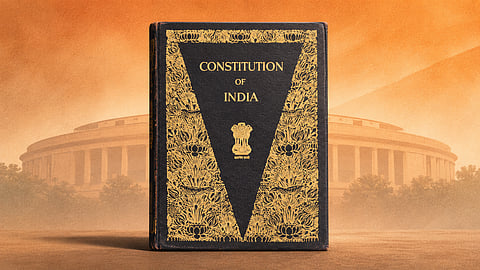

THE BJP’S PROJECT UNDER Narendra Modi is better understood as subversion and not assault. An assault suggests an attack from outside, a repudiation of the constitutional order. Subversion works from within. It exploits the authority, ambiguities and institutional arrangements of the existing order. The Modi government has not needed to overthrow the Constitution. It has been able to pursue a fundamental transformation of the Indian state through the very powers and institutions that the Constitution places at its disposal.
This argument does not require us to idealise the Constitution or celebrate it as a republican achievement. The Constitution was not the product of a directly elected sovereign constituent body. It retained much of the colonial state apparatus and its coercive logic, vested considerable power in the Union executive and provided weak mechanisms for holding those exercising state power accountable to the people. Its institutional checks and balances were feckless, and its promise of popular sovereignty remained mediated through representative institutions distant from ordinary citizens. It retained structures of social domination and oppressive processes, merely cloaking them in a republican veneer. The constitutional order did possess vulnerabilities to authoritarian and majoritarian appropriation than possibilities for democratic advance.
The Modi regime has exploited these vulnerabilities along four major interconnected fronts: the displacement of secularism by communal majoritarianism; the hollowing out of constitutional institutions; the erosion of federalism; and the securitisation of dissent. Together, they constitute a transformation of the relationship between the state, institutions and citizens. The constitutional forms remain. Elections continue, Parliament meets, courts function, Governors occupy constitutional offices, and federal arrangements appear intact. But these forms increasingly conceal a grotesque distortion of their substantive purpose, threatening the very idea of a republic.
Majoritarianism and the subversion of secularism
Indian secularism was compromised from its inception. The Constitution did not establish a strict separation between religion and the state. It retained religion as a public and administrative category, permitted state intervention in religious institutions and accommodated personal laws organised along religious lines. Its conception of secularism was consequently open to competing interpretations. Its deformities were visible right at its birth. Nevertheless, it sustained a fiction of religious freedom and the protection of minorities.
The BJP’s ideological project has largely dispelled this fiction. The state is no longer merely accommodating the political mobilisation of Hindu identity; it is made an instrument of a political conception of the nation. Muslims, in particular, are being relegated to an increasingly insecure and unequal position within the polity. The Citizenship (Amendment) Act, with its selective religious criteria for fast-tracked citizenship, gave this majoritarian conception a legislative expression. The politics of cow protection, anti-conversion laws, the mobilisation around the Ram temple and the normalisation of anti-Muslim rhetoric have reinforced it in public life. The abrogation of Article 370 and the reorganisation of Jammu and Kashmir, though upheld by the Supreme Court in its 2023 judgment, also demonstrated the capacity of the Union government to pursue a profound political reordering of a state without meaningful consent from its elected representatives.
The significance of these developments lies in the change of conception of citizenship itself. The constitutional promise of a political community in which religious identity does not determine one’s standing is being displaced by a majoritarian understanding of the nation. The state increasingly legitimises the political dominance of the religious majority. This is a subversion of secularism even in its limited commitment to religious equality.
Constitutional institutions are supposed to mediate the exercise of state power, provide checks on executive authority and protect the rights of citizens. Their effectiveness depends on their independence and capacity to act without political pressure. The Constitution did not provide sufficiently robust safeguards to ensure such independence. Many institutions were vulnerable to executive influence through appointments, tenure, administrative control and financial dependence. These vulnerabilities did surface in the past but largely their autonomy was substantially assumed as political convention.
The Modi regime has exploited them to the hilt. The Election Commission, investigative agencies, regulatory bodies and even the judiciary have increasingly come under the shadow of executive dominance. Investigative agencies such as the Enforcement Directorate and the Central Bureau of Investigation were particularly abused for political purpose. Their selective targeting of opposition leaders and government critics has become notorious. The issue is not that these agencies were not abused under earlier governments; it is that their deployment has become an important instrument of political management.
The treatment of judicial and quasi-judicial institutions offers a revealing illustration. In Dr Jaya Thakur v. Union of India (2023), the Supreme Court held that the extensions granted to the then Enforcement Directorate Director were invalid because they breached an earlier specific direction of the Court. The judgment distinguished the validity of statutory amendments permitting extensions from the government’s failure to comply with the binding direction in that particular case. More recently, in Madras Bar Association v. Union of India (2025), the Supreme Court struck down provisions of the Tribunal Reforms Act, 2021, because Parliament had reintroduced provisions previously invalidated by the Court without curing the underlying constitutional defects. The Court characterised this as an impermissible legislative override, implicating judicial independence and separation of powers. These cases illustrate a governing approach in which institutional restraints are not simply disregarded but repeatedly tested and circumvented through legislative and executive power.
Parliament itself has suffered a serious decline in its capacity to scrutinise executive action. The functioning of the Seventeenth Lok Sabha is instructive. According to PRS Legislative Research, only 16 per cent of its Bills were referred to parliamentary committees; 58 per cent were passed within two weeks of introduction, and 35 per cent were passed with less than an hour of discussion in the Lok Sabha. These practices do not necessarily constitute constitutional violations: the Constitution prescribes no general minimum period of debate or mandatory committee referral. But their systematic neglect weakens the deliberative and supervisory functions through which Parliament is expected to hold the executive accountable. A legislature reduced increasingly to ratifying government decisions cannot serve as an effective check on executive power.
The problem, therefore, is the widening gap between the formal independence of constitutional institutions and their actual capacity to restrain the government. The institutions survive, but their autonomy is progressively hollowed out.
The Constitution established a strong centralised Union, giving the Centre substantial powers over the states. Federalism was therefore never an arrangement between equal constitutional partners. Yet the practical functioning of Indian federalism developed beyond the original constitutional design. The rise of regional parties, coalition governments, political competition and the administrative necessities of governing a diverse country created spaces for state autonomy and federal accommodation. These were political achievements more than constitutional guarantees.
The Modi regime has systematically narrowed these spaces. Governors have increasingly been used as instruments of political pressure against opposition-ruled state governments, with delays in assenting to legislation, disputes over appointments and interventions in legislative affairs. Central investigative agencies have become part of the political contest between the Union and state governments. Fiscal centralisation and the increasing dependence of states on centrally controlled resources have further weakened their bargaining position. The elected governments of opposition-ruled states are frequently treated not as constitutional partners but as political adversaries to be contained.
The political crises in Arunachal Pradesh and Uttarakhand during the earlier phase of BJP-led central rule provide examples of the use of constitutional offices and provisions to destabilise elected state governments. In Nabam Rebia v. Deputy Speaker (2016), the Supreme Court invalidated the Governor’s actions in advancing the Assembly session and intervening in its proceedings. In Uttarakhand, the High Court quashed the proclamation of President’s Rule under Article 356, holding that it had been issued contrary to the law laid down by the Supreme Court in S.R. Bommai. These decisions demonstrate how constitutional powers intended to preserve constitutional government can be used to undermine elected governments.
The treatment of Jammu and Kashmir represents an even more consequential development. In 2019, the state was reorganised into two Union Territories after the abrogation of Article 370, while it was under President’s Rule. Notwithstanding the Supreme Court—itself shrouded in suspicion—upholding it, the episode raises a larger question about the meaning of federalism when the Union can fundamentally alter a state’s constitutional and political status without the consent of an elected state government. The subsequent prolonged absence of statehood further underlines the imbalance. What is being eroded is not merely a particular constitutional provision but the political understanding that a diverse country cannot be governed sustainably through the unrestrained predominance of the Centre.
The use of coercive laws against dissent is not an innovation of the Modi regime. Independent India inherited colonial laws and institutions of repression, expanded them, and successive governments used them against political opponents, social movements and insurgencies. Preventive detention, sedition, anti-terror legislation and the criminalisation of protest have a long history. The Modi regime’s distinctive contribution lies in the scale, normalisation and political integration of these instruments into a broader project of majoritarian consolidation.
The Unlawful Activities (Prevention) Act and the Prevention of Money Laundering Act have been used in cases involving activists, journalists, academics, political opponents and civil society organisations. Prolonged incarceration, stringent bail provisions and the slow pace of trials mean that punishment can effectively precede conviction. The process itself becomes a form of coercion. Protest movements are increasingly framed as threats to national security, while criticism of government policy is readily conflated with disloyalty or anti-national activity. Civil society organisations face restrictions, investigations and administrative pressures that constrain their ability to operate.
This securitisation of dissent changes the relationship between citizens and the state. Dissent, which ought to be a normal feature of democratic politics, is recast as a security problem requiring surveillance, investigation and coercive intervention. The state increasingly claims the authority to decide which forms of political expression are legitimate and which constitute threats to national integrity. The recent Gen Z and anti-SIR protests exemplify it. The constitutional guarantees of civil liberties remain formally intact, but the loopholes and exceptions built with it have hollowed out their substance, rendering them increasingly ineffective. The colonial state’s coercive inheritance is thus being deployed with renewed force in the service of a majoritarian political order.
The four developments described above point to a deeper problem that receives surprisingly little attention in debates about constitutionalism: the absence of accountability to the people. The Constitution proclaims popular sovereignty, but the institutions through which that sovereignty is exercised remain insulated from popular control. The executive derives authority from a parliamentary majority, but the mechanisms for scrutinising its conduct are weak. Parliament’s oversight can be neutralised by a majority; constitutional institutions depend on conventions and restraints that those in power can disregard; and judicial remedies, even when available, are often delayed, if not denied.
The first-past-the-post electoral system compounds this problem. It allows a party to convert a minority of votes into a commanding parliamentary majority, which can then be presented as an unqualified popular mandate. Electoral victory becomes an alibi for the concentration of power rather than a mandate subject to continuing public scrutiny. The Constitution provides for periodic elections, but elections alone cannot ensure democratic accountability. Between elections, citizens have little power to compel the government to explain its actions, reverse arbitrary decisions or respond to public demands.
This reflects a serious structural deficiency in the constitution. The Constitution places considerable faith in representative institutions, the separation of powers and the restraint of those exercising public authority, but it does not provide effective mechanisms to ensure that these restraints operate when a government commands a parliamentary majority and controls the institutional levers of the state.
It is in this context that the increasingly frequent invocation of constitutional morality needs to be examined critically. Ambedkar’s warning that constitutional morality had to be cultivated, rather than presumed, is often cited as though the survival of constitutional government depended primarily on the moral disposition of those who occupy public office. But this invocation can become a substitute for confronting the institutional and structural deficiencies that make constitutional subversion possible.
Ambedkar did not treat constitutional morality as a magical safeguard. His concern was with the habits, restraints and institutional practices necessary for constitutional government to function. But the present discourse often detaches the concept from these conditions and turns it into a moral injunction addressed to political actors. What happens when those exercising power have no incentive to observe constitutional restraints? What happens when institutions lack the independence or authority to enforce them? What happens when electoral majorities are used to legitimise the weakening of the very institutions meant to limit governmental power?
Constitutional morality cannot substitute for institutional independence, enforceable restraints on executive authority or effective popular accountability. Nor can invoking Ambedkar transform the existing constitutional arrangement into an adequate instrument of democracy. To appeal to constitutional morality without examining the constitutional distribution of power is to turn a political and institutional crisis into a question of individual virtue. It risks obscuring the more difficult question of how power is structured, exercised and held accountable.
The Modi regime’s subversion of the Constitution has been possible because of the vulnerabilities of the constitutional order. Its limited secular commitments, executive predominance, weak institutional safeguards, centralised federal structure, inherited coercive machinery and inadequate mechanisms of popular accountability have provided the openings through which this transformation has proceeded. Modi has perhaps done little that did not have some precedent under previous governments. His distinctive contribution has been to stretch inherited them to their limits, deploying them systematically in the service of his majoritarian project. This historical continuity has also provided the BJP/RSS with a convenient defence of ‘whataboutery’ : every charge against the Modi regime is met with counter-examples from the past, as though the existence of earlier abuses absolves the present government of responsibility for their unprecedented scale, intensity and political purpose.
The response to this state cannot be a nostalgic return to an idealised constitutional past. Defending the limited democratic gains embodied in the Constitution remains necessary, particularly when they are under sustained attack. But this defence must not become an excuse for evading the Constitution’s own historical and structural limitations. The crisis, therefore, is larger than the conduct of one government. The Modi regime has squarely exposed the limitation of the constitutional order. To defend democracy, it is necessary both to resist the present subversion and to confront the constitutional deficiencies that have enabled it. The alternative to constitutional subversion cannot be constitutional nostalgia. It must be democratic reconstruction.
Anand Teltumbde is a former CEO of Petronet and professor at IIT Kharagpur and GIM, Goa. He is also a writer and civil rights activist.
