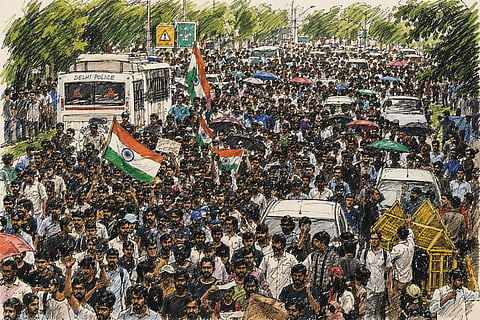

WHEN THE PEOPLE gathered at Jantar Mantar this Monday, fasting and chanting and holding copies of the Indian Constitution above their heads to demand that a Union minister answer for a leaked examination that had upended a generation, the Government of India had a tidy explanation for why they were blocked, detained and brutally beaten up: they had no ‘permission’, and that the gathering was unauthorized.
It is worth pausing on that word, ‘permission’. Permission is something superiors grant to subordinates, and to say that citizens may protest only with the government’s leave is to make the freedom to dissent, a favour the powerful lend to the powerless, revocable the moment it turns inconvenient. That is precisely what a fundamental right is not. The real question is this: is it right to protest without permission, and what does an unarmed protest carry that a free country must protect even when the paperwork is not in order?
To answer, it helps to begin far from Delhi. On October 21, 1967, outside the Pentagon, a girl of seventeen named Jan Rose Kasmir stood before a line of soldiers with fixed bayonets, holding a single chrysanthemum. Marc Riboud’s photograph of that moment has travelled further than most armies: on one side of the frame, helmets and uniforms and steel; on the other, a young woman with no hatred in her face, holding something that could be crushed between two fingers.
A flower cannot stop a bullet, but it can make the bullet explain itself. That is the power of peaceful protest, and why the quarrel over permission misses what matters most. The law asks whether the gathering was ‘authorized’, whether the road was blocked, whether order was disturbed. History, however, asks a harder question: what kind of order needs a bayonet to defend itself against a flower?
