
“Whatever one’s preferred route to the constitutional court, there has always been a current of resistance […] against the repressive power of the State. Democratic lawyering must, therefore, also serve as a dual function: as a shield against authoritarianism as well as a vehicle for social and economic transformation.” (emphasis mine) (Page 44)
“Feminist lawyering, however, begins from a different premise. It accepts that men and women do not occupy equal footing, and the liberal notion of equality between equals is, therefore, structurally inadequate.” (emphasis mine) (Page 47)
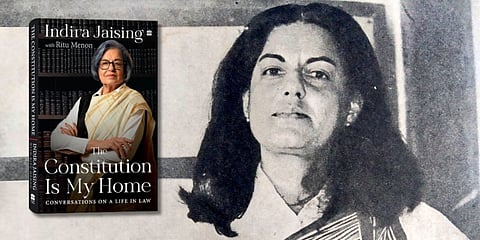
INDIRA JAISING has come out with her memoir – 'The Constitution Is My Home' – and the questions start creeping in right from the first claim: the title. To talk of a constitution as a ‘home’, often referred to as a masculinist hegemonic apparatus of power, as British historian Linda Colley does, discomforts a hasty interlocutor, like me, right at the first note. The affective connotation, “My Home”, is a rare observation, and hence also invites the reader to dive deeper into this dialogical treatise. By the end of the book, one could question whether it is a memoir or a compendium of epochal conversations between the Indian judiciary and multiple public(s).
Writing a review of this short (about 200 pages) but dense book has been quite challenging, not because of Indira Jaising’s grandiose but by virtue of the multiple worlds and words that are consecutively being named and brought to life in this book. For a review like this, there could be two axes of organisation – firstly, chronological, i.e. organising the review documenting the historical occurrences and noting the response of the judiciary to the challenges that the subcontinent put it through; or, secondly, thematic, wherein the different themes of the book could be recorded as flowing organically from Indira Jaising’s responses to Ritu Menon’s questions.
This review is organised around the latter axis to highlight the entanglement of various publics with the judiciary, woven into organically flowing themes, and Jaising, as a narrator, stands at a crucial juncture within those epochal moments, guiding us through the journey.
The book is built from conversations between Jaising and Menon, a feminist writer and publisher, and is divided into nine chapters, along with an Author’s Note. Jaising, in these conversations, as the title of this review suggests, centres lawyering and its multiple interactions with the courts and publics outside. These publics sometimes move, and are at other times moved by the Court. For Jaising, the way forward, as her life’s work, is through “secular feminist lawyering” (emphasis mine) (Page 54).
Combining the broader tenets of feminism and praxis of secularism while holding the institution accountable to the republic’s founding promises (justice, liberty, equality, fraternity and dignity) on the much-contested site of liberal/democratic constitutionalism, Indira poses the questions “Why do you practise law? […] how one practises law, and for whom [sic]” (Page xii). While Jaising is the central protagonist, she puts two other characters under the spotlight – the Courts and the Public(s).
She locates herself and the constitutional courts as bridges. Herself, as a bridge between the struggling masses through their activist organisers and the courts. Courts, as bridges between transformative constitutionalism and the constitution, since they hold the potential to interpret “the Constitution as a tool of social change” (Page 50). Jaising takes the reader through the dilemmas confronting lawyers (not just a woman lawyer) who work in harmony with their conscience.
In the Author’s Note, Jaising characterises the Constitution as her “companion” (Page x), contradicting its usual static placement within glass cases. As a usual commuter within the alleys of the India’s highest constitutional court, Jaising’s first radical act in the book is of mobilising and animating the constitution by taking it out of the glass case, like the case situated at the entrance of the Supreme Court Bar Association’s Library 1, which is emblematic of the spectacular trope of constitutionalism of recent times.
With the slow demise (or decline) of constitutionalism, the spectacular signification of the Constitution has risen, whereby its metaphorical epitome was recently seen when a private university launched a Constitution Museum, something which Jaising herself finds antithetical to the idea of the constitution and calls on lawyers to –
“ensure that the Constitution does not become a museum piece, consigned to the dustbin of history.” (emphasis mine) (Page 173)
Therefore, while readers have the leisure to read this as a ‘history of judiciary’ textbook complemented by contemporary anecdotes, any reading of the book must be complemented by a deliberate political reading of contemporary times, which observes accelerating constitutional decline and democratic backsliding. She ends the Note with a hope of working “towards greater accountability from our judges and deeper fidelity to the Constitution” (emphasis mine) (Page xii). As a feminist undertaking, Indira Jaising uses fidelity and chastity only metaphorically, thereby erasing any gendered and sexualised connotations, thereby committing the book to an embodied feminist scholarship.
In the thematic overview, four themes stand out to me, personally, and the book can be reorganised into these four themes –
1. Constitutionalism and Courts: As They Are and As They Should Be!
Jaising highlights the stark contrast between the judiciary’s emancipatory ideals and its systemic failures. While courts can establish normative frameworks for rights, entrenched institutional barriers frequently marginalise women and preserve legal privilege for a select few. She exposes a severe deficit in executive accountability and judicial transparency, advocating structural reforms such as live-streaming of Supreme Court proceedings to combat institutional complicity and secretive judicial behaviour.
2. “What law must do?”: Publics, Protests, and Positions
Because formal justice remains fundamentally inaccessible to most citizens, Jaising argues that public protest serves not as an antithesis but a moral extension and engine for legality. She insists that personal laws must be rigorously sanitised of religious influence to protect individual agency, privacy, and a woman's right to escape violence.
Furthermore, she forwards the purpose of law alongside its task of preserving an inclusive “idea of India” that recognises the shared heritage of the subcontinent, warning against the dangerous conflation of regional migration with formal immigration.
3. The Multiple Wor(l)ds of Lawyer-ing
Jaising conceptualises advocacy through three intertwining strands: democratic, feminist, and secular feminist lawyering (‘SFL’). While democratic lawyering leverages the Constitution to expand welfare-based governance, feminist lawyering moves beyond the illusion of formal equality to demand substantive equality based on lived experiences. Ultimately, she advocates for SFL—synthesising B.R. Ambedkar and the feminist legal scholar Catharine MacKinnon—to actively separate religion from personal law, resist the communalisation of gender issues, and dismantle interlocking hierarchies of caste and patriarchy.
4. Conceptualising a Post-Colonial Indian Jurisprudence
Synthesising her broader insights, Jaising identifies a profound structural crisis: a regression from emancipatory constitutionalism to ideological and institutional capture. However, the book, instead of being viewed merely as a memoir, should be treated as a formative lesson in theory-building. She traces the republic’s radical, anti-colonial founding, critiquing the contemporary shift towards cultural nationalism, discriminatory citizenship laws, and compliant “Surajmukhi” (sunflower) courts that bow to the executive. Warning against the depoliticisation of grassroots movements through an over-reliance on the courts, she details a bleak transition from dynamic democratic lawyering to an urgent, exhausting era of defensive lawyering.
That being said, here’s a note of caution. The list of themes that I mention are inexhaustive. There can be several more themes; for instance, a theme on the publics that move the court through Indira Jaising. These publics are central for her story of landmark cases which are usually invisibilised under the landmark tag. However, to do justice to the book and these publics, I decentre them for the time being and forward these four themes. The book talks about an epoch, i.e. Jaising’s time at law courts, populated by multiple milestone cases. These cases have popular mobilisation in the background, manifesting in landmark judgments in the front. Therefore, both the popular and legal sites are central to Jaising’s story and to this book.
Another theme could easily be the landmark cases which Jaising explains in crisp detail. By revisiting these cases through a senior’s expertise, the book takes a pedagogical turn.
Jaising also places the personal at the core of ‘political’. While I have tried to accommodate her “personal” into the review, I have failed massively. A separate theme, therefore, could have been designed around the idea of “political is personal” and “personal is political” – she talks about her experiences as a lawyer in masculine-coded law courts defending rights and gender justice. Jaising shows her entanglements with the aggrieved and argues that being personally connected to the aggrieved doesn’t compromise objectivity. This rhetoric of objectivity, she argues, leads to ‘commercialisation’ of the legal profession and reduces the vision of justice that gives legal and moral force in the court of law.
Therefore, in this review, I discuss the interface of legality, politics, and ethics, for which this book stands out in the corpus of literature on constitutional studies.
Some critical thoughts
While Indira Jaising presents a critical reading of the court’s behaviour and its interaction with other agents of a constitutional republic, the eternal optimist in her takes over every time she concludes her arguments. Even though she highlights the tragedies and insurmountable pressures that the marginalised in India face, she does not end the observation in dismay or despair.
For instance, Jaising notes how the Parliament, on occasions, has corrected the errors of the judiciary, highlighting the Janata Dal government’s amendment in the domain of state emergency. This understanding, however contextual and subjective, gives a positive gloss to the executive’s sidelining of judicial orders, leading to a downward slide in the courts' legitimacy. The conceptual trope of “legislative correction” is overlooked in her discussion of the Muslim Women (Protection of Rights on Divorce) Act, 1986 passed by the Rajiv Gandhi government in response to the Shah Bano judgment (1985).
There have been contemporary instances, such as the absolute dismissal of the Anoop Baranwal judgment (2023). In the judgment, the Supreme Court had ordered that the Chief Election Commissioner and Election Commissioners be appointed by a panel comprising the Prime Minister, the Leader of the Opposition, and the Chief Justice of India. However, the Parliament led by the majoritarian Executive later passed the Chief Election Commissioner and Other Election Commissioners (Appointment, Conditions of Office and Terms of Office) Act, 2023, ‘legislatively overruling’ the judgment. Therefore, if read against the terms of an eternal optimist, what Jaising suggests about the Indian legal system fails to hold ground when tested under duress, especially under times like these.
Secondly, what she mentions as “mindset”, which “has gradually shifted”, in the case of judges adhering to the principle of equality and dignity on issues of gender and caste, is really a euphemism for the nature of Brahminical patriarchal institutions. In recent judgments, which I criticise separately, the Supreme Court has shown its inability to correctly comprehend caste as a social institution. Jaising saw herself at odds with the Brahminical order retaliating against the UGC Equity Regulations of 2026. Therefore, what looks like a gradually shifting mindset, occludes the real texture and fabric of judiciary’s functioning. The Courts do not incidentally make mistakes in comprehending issues related to atrocity and conversion in respect of caste. Rather these courts battle “an inadvertent cognitive blindness” as Tanweer Fazal rightly suggests. Therefore, to look at the ‘mindset’ of the courts and its members as shifting gradually, erases the struggles that marginalised face (and have historically faced) at the doors and alleys of these Courts. The real nature of these institutions must be problematised for their tendency to maintain the status quo rather than be appreciated for a gradual shifting ‘mindset’.
Thirdly, having observed Indira Jaising in the recent nine-judge bench Sabarimala Reference, the reader wants to question her about the rights of institutions to manage religious affairs under Article 26. Jaising views Article 26, as it appears in the book, as a collective of individual rights under Article 25, and argues that “temples, churches, mosques and agiaries exist to facilitate the collective exercise and expression of an individual right” (Pages 97-98). I place this more as an inquisition rather than a critique. By locating Article 25 as a gateway of Article 26, she falls into the domain of West’s liberal constitutionalism that places the individual at the centre and displaces the community from consideration.
Finally, Jaising presents a rosy history of constituent power enabling the creation of a new state that inherited laws and was not destined to work with them. The binary of inheritance and destiny excites the reader and pleases the rhetorics, but also forwards an account which must be complemented by the fact that the constituent power and thereafter, the expression of will of the people (the Parliament) chose not to do away with restrictive laws (like, for instance, sedition), which is what must be criticised as coloniality of the modern Indian state, even if it is not seen as a continuity of the imperial colonial project.
In all, Indira Jaising’s memoir works less as a nostalgic piece of literature and more as a secular feminist manifesto, with the potential to delineate a Theory of Post-colonial Indian Political Thought and Jurisprudence. Her journey as an officer of the court and the government, along with her role as a progressive advocate, illuminates the various dimensions of the legal world. This illumination is accompanied by a treatise on the ethics and politics of the Indian constitution, resembling political theorist Rajeev Bhargava’s edited volume, in which the Constitution is at the centre, and Jaising takes the reader on a tour of the various territories of constitutionalism.