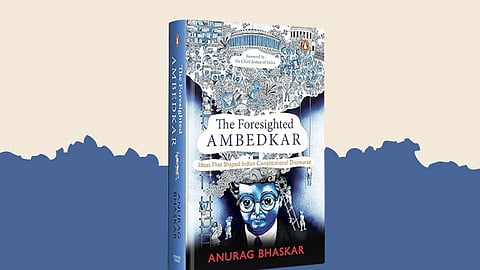

Review of ‘The Foresighted Ambedkar: Ideas That Shaped Indian Constitutional Discourse’, Penguin Random House India, Hardbound, Pages: 400, INR 799
WHEN WE THINK OF Dr Bhimrao Ambedkar, we understand that his legacy is one that evolves through their sustained relevance in the challenges that we contemporarily confront. The book ‘The Foresighted Ambedkar: Ideas That Shaped Indian Constitutional Discourse’, written by Anurag Bhaskar further establishes the evolutionary personality of Ambedkar’s many contributions, particularly how those contributions have been interpreted, at times perhave even exploitatively by some.
Most often while assessing Dr Ambedkar’s contribution in the formation of Indian Constitution, we tend to confine ourselves merely to his immediate presence in constituent assembly. But this myopic approach to understand Dr Ambedkar’s contribution suppresses his long and enduring struggle that was of a more encompassing character
Bhaskar’s book plays a decisive role in debunking myths surrounding Dr Ambedkar including his alleged desire to burn the Constitution and his proposal for reservations in employment and education to be discontinued after ten years. Bhaskar also prominently disagrees with writers like Arundhati Roy and Shashi Tharoor who have widely claimed that Dr Ambedkar did not pursue the cause of Schedule Tribes (‘ST’) and provides a detailed description of Dr Ambedkar's contributions towards Adivasi and forest dweller communities.
In the recent times, while attempts are being undertaken to really redefine constitutional jurisprudence in India, the formidable repute of Dr Ambedkar is being debated heavily, both inside the Parliament and outside. In this context, Bhaskar’s book becomes an urgent read for everyone.
Layout of the book
The book runs through ‘twenty-one’ chapters ranging from his early life to his educational achievements, which ultimately shaped Dr Ambedkar’s socio-political ideology which he asserted throughout his life. In the initial two chapters of the book Bhaskar depicts the early life of Dr Ambedkar, his early engagement with caste, family, his father’s profession, the education which he received in India as well as abroad and the atrocities which he faced “as Dalit and as a Dalit professional”.
Followed by this, Bhaskar delves into colonial constitutional reforms in two phases. The first phase captures the years preceding 1915 - this phase preserved the interest of upper caste ruling elite only as the dual policy of non-interference and codification of customs effectively enabled the power of Brahmins to maintain pre-existing subaltern trajectory. The second phase, from 1915 to 1950, begins with the advent of Dr Ambedkar in constitutional discourse, wherein he brought true constitutional philosophy, a radical departure from governance to human right based governance, and demanded a just and inclusive social-contract for all.
Further, Bhaskar’s work examines Dr Ambedkar’s ideas on popular government and citizenship, highlighting how Ambedkar viewed democracy as more than just elections and majority rule. He believed that true democracy required social and economic justice, with fair distribution of resources to enable marginalised communities to participate equally in politics. Through Ambedkar’s speeches and debates, Bhaskar shows how Ambedkar’s focus on linking political democracy with economic justice shaped his constitutional vision. Dr Ambedkar opposed the idea of democracy based solely on numerical majorities, instead advocating for constitutional safeguards to protect minority rights, especially for Dalits and oppressed castes.
Subsequently, Bhaskar stated that Ambedkar used the language of rights to situate the concerns of the Depressed Classes. In order to accomplish this, he set forth two aims: first, to awaken the consciousness of the Depressed classes, and second, to place their concern before the British authorities and within the national discourse.
The book analyses key moments in Ambedkar’s political career, focusing on the Mahad Satyagraha as a significant event that shaped his legal and constitutional ideas. This struggle for the right to access public water sources symbolised a broader fight for equality and social justice. Bhaskar also highlights Ambedkar’s seminal support for universal adult franchise, advocating for equal voting rights for all citizens despite widespread illiteracy and social divisions. This push for democracy was core to Ambedkar’s vision for a just India and continues to influence the fight for equality and representation in modern society.
Furthermore, the book presents the tyranny of meritocracy—that reservation would suppress merit and in return efficiency in administration would be compromised. Ambedkar made it clear that the education system in India has been overwhelmingly undemocratic, Backward Classes had been denied access to education from the dawn of history. According to him, the notion of ‘efficiency of administration’ was an exclusionary construct in the colonial and pre-colonial era. Bhaskar carefully analyses Ambedkar;s a decisive role in securing the inclusion of Backward Classes in the colonial administration through his efforts at all three 'Round Table Conferences.' These efforts ultimately led to the recognition of the rights of Backward Classes in the final draft of the Government of India Act, 1935.
In addition, Bhaskar pointed out Dr Ambedkar’s idea of ‘Annihilation of Caste from a constitutional perspective, which was guided by the vision that political reform could not happen unless it was accompanied by social reform which could capably address structural discriminations. He proposed that an ideal society, devoid of caste hierarchy “would be society based on liberty, equality and fraternity.”
Bhaskar also explores Ambedkar’s views on the structure and functioning of government. The book highlights Ambedkar’s strong support for a system of checks and balances, his advocacy for an independent judiciary, and his belief in federalism as a way to address India’s complex social and linguistic diversity. Bhaskar examines Ambedkar’s role in key debates within the Constituent Assembly to show how his ideas about governance structure were shaped by both a profound understanding of constitutional principles and a practical recognition of India’s unique social and political challenges.
From chapter thirteen to chapter nineteen, Bhaskar offers a detailed exploration of Ambedkar’s monumental contributions to institution building in India. Beginning with ‘Foundations of the Indian Constitution’, Bhaskar traces how Dr Ambedkar laid the groundwork for a democratic framework. The discussion then moves to the ‘Interrelation between Civil-Political and Socio-Economic Rights’, highlighting Ambedkar’s holistic vision of justice. In ‘Being Chosen as Chairman of the Drafting Committee and Constitution-Making’, the narrative focuses on the critical role Ambedkar played in drafting the Constitution. The subsequent chapters, ‘Conditions Precedent for the Successful Working of Democracy’ and ‘A Constitutional Vision for Political Democracy’, Bhaskar underlines Ambedkar’s foresight in outlining the essential conditions and principles necessary for sustaining a vibrant democracy.
The last two chapters are particularly focused on debunking myths. As previously mentioned, there is a common misconception that Dr Ambedkar wanted to burn the Constitution and believed that reservation provisions should end ten years after the Constitution’s adoption. Bhaskar addresses this historical error in detail, correcting the misrepresentation with thorough analysis and appropriate references.
Bhaskar’s work provides a comprehensive and insightful exploration of Dr Ambedkar’s multifaceted contributions to India’s constitutional, political, and social landscape. Bhaskar crafts a narrative that not only celebrates Ambedkar as the architect of modern India but also challenges readers to reconsider the conventional myths surrounding his legacy. The book’s detailed examination of key events, such as the Mahad Satyagraha and the drafting of the Constitution, serves not just as historical recounting but as a powerful documentation of Dr Ambedkar’s relentless struggle against injustice. The myth-busting chapters, in particular, are not just corrective footnotes; they are deliberate confrontations with the sanitised versions of history that often overshadow Ambedkar’s radicalism. Bhaskar does not only recount Ambedkar’s achievements but compels us to struggle with the uncomfortable truths and enduring contradictions of his journey, making this work both enlightening and provocatively reflective.